
Executive Summary:
- NICE Information & Telecommunication sits at the intersection of Korea’s offline payment infrastructure (VAN) and online payment processing (PG), with TRS tax refund services rounding out the platform. The business earns fees across authorization, routing, settlement-related processing, and tax refund services — and that structure is now showing measurable earnings improvement.
- 2025 operating profit reached KRW 55.3B (approximately US$38.1M) on KRW 1,094.7B revenue, with operating margin recovering to 5.1% from 4.1% in 2023. The 2026Q1 margin held at 5.2%, suggesting this is more than a one-quarter rebound — though margins remain below historical peaks and further improvement is needed.
- The KIS Information & Communication acquisition (96.1% stake for KRW 112.3B, decision announced June 2, 2026) is expected to boost consolidated operating profit by 25–30%. Actual consolidation timing is to be confirmed in subsequent filings — the scheduled acquisition date was July 2, 2026.
- Concurrent shareholder return actions — 900K treasury shares canceled (9.0% of outstanding), additional KRW 3B share buyback, stock split, and DPS increase to KRW 1,100 — make this one of the more concrete “value-up” packages among Korean mid-caps.
- Key risk in one line: KIS is a related-party transaction (seller is parent NICE Holdings), and the KRW 112.3B acquisition price vs. KRW 85.5B book value (KRW 26.8B premium) will face ongoing scrutiny against the KRW 17.7B shareholder return package.
Investment View in One Line
Core earnings are recovering, KIS adds a step-change in consolidated profit, and management is backing it with real shareholder return actions. The question is whether margin improvement is durable — and whether the group-internal acquisition structure clouds the value-up narrative.
Why This Stock Matters
In Korea’s payment infrastructure landscape, the difference between “processing transactions” and “running the rails” is visible in margins and cash conversion. NICE Information & Telecommunication processes card authorizations through VAN, routes online payments through PG, and handles tourist tax refunds through TRS — all on infrastructure it owns and operates, including dedicated IDC and DR centers running 365 days without interruption.
What makes the current moment interesting is the convergence of three factors: core business margin recovery (OPM from 4.1% to 5.1%), the KIS acquisition adding 25–30% to consolidated operating profit, and a shareholder return package that goes beyond announcements. Management committed to canceling 9.0% of outstanding shares while raising dividends for the third consecutive year. That combination — earnings improvement plus capital return plus inorganic growth — is uncommon among Korean payment infrastructure names.
All currency conversions in this article use an approximate exchange rate of KRW 1,450 per US$1, unless noted otherwise.
Core Investment Thesis
1. KIS acquisition: consolidated earnings step-up
On June 2, 2026, NICE Information & Telecommunication announced the acquisition of a 96.1% stake in KIS Information & Communication from parent NICE Holdings for KRW 112.3B (~US$77.4M). The scheduled acquisition date was July 2, 2026; actual consolidation timing and earnings impact should be confirmed through subsequent filings. KIS posted 2025 revenue of KRW 216.5B, operating profit of KRW 15.5B, and net income of KRW 12.7B (~US$8.8M). This is not a transaction designed to instantly boost book value per share — it is structured to increase EPS and ROE by combining KIS’s payment processing volume with NICE’s existing VAN/PG infrastructure, reducing fixed-cost ratios through system integration.
2. Shareholder return: actions, not just announcements
Treasury share cancellation of 900K shares (9.0% of outstanding), an additional KRW 3B buyback program, stock split, and DPS increases from KRW 730 (2023) → KRW 810 (2024) → KRW 1,100 (2025) with a stated policy of 10%+ annual DPS growth through 2028. This is a concrete execution package, not a forward-looking promise.
3. Digital payment infrastructure optionality (CBDC, stablecoins)
If CBDC, deposit tokens, or KRW/USD stablecoins are ever used at offline merchants, they will need the same POS, terminal, settlement, cancellation, and refund infrastructure that NICE already operates. Competitor KS-Net is already moving on stablecoin payment rails. This is a medium-to-long-term option, not a near-term earnings driver — there is currently no revenue contribution from CBDC or stablecoin-related services.
Business Model
The business earns fees wherever money moves. VAN relays transaction data between merchants and card companies for offline payments. PG routes online payment data between e-commerce platforms and financial institutions. TRS handles tax refund processing for foreign tourists. Approximately 46% of revenue comes from the NICE Payments online payment intermediation segment, making it the growth engine, while VAN and TRS provide steady baseline cash flows.
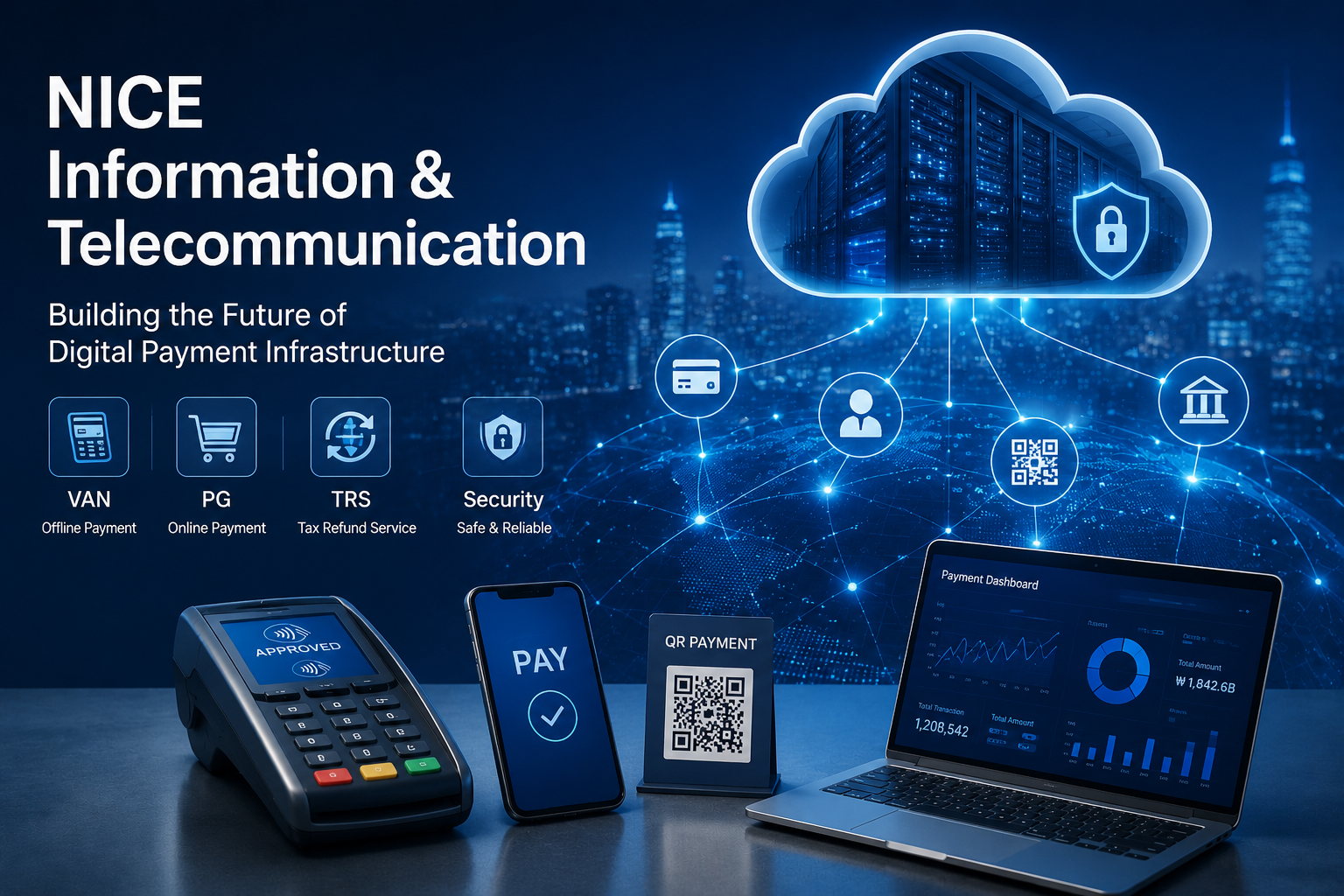
The company operates its own IDC center and DR center, which is not incidental — in a business where even brief downtime can disrupt large volumes of payment transactions, proven uptime is the real competitive moat. This infrastructure investment also creates a natural barrier to entry for new competitors.
| Segment | % of Revenue | Description |
|---|---|---|
| NICE Payments online intermediation | 46.0% | E-commerce payment processing (PG relay) |
| VAN / SSL-SET / TRS | 27.0% | Card authorization relay + security + tourist tax refund |
| PG online intermediation | 15.6% | Online payment data routing and settlement |
| Payment system development & maintenance | 4.3% | System development / maintenance services |
| Card inquiry / SSL-SET solutions | 2.9% | Authorization-linked inquiry and security |
Financial Performance
The direction is right. 2025 revenue hit KRW 1,094.7B with operating profit of KRW 55.3B, recovering more than 50% from the 2023 trough. Operating margin rose from 4.1% to 5.1%, and 2026Q1 held at 5.2% — this looks like structural improvement, not just a base effect. That said, OPM remains below historical peaks (the company has previously achieved 6%+ margins), so further improvement is still needed.
OCF interpretation requires caution. It jumped from KRW 13.7B in 2024 to KRW 163.6B in 2025, but in a payment processing business, merchant settlement timing and working capital swings can dramatically distort annual cash flow figures. Reading this as a 10× improvement in cash generation would be misleading — OCF should be evaluated on a 2–3 year rolling average alongside the net-income-to-cash conversion ratio. The operating profit trend is clearly improving; whether cash flow structurally follows is something the next few quarters will answer.
| Item | 2022 | 2023 | 2024 | 2025 |
|---|---|---|---|---|
| Revenue | 804.9 | 891.6 | 975.1 | 1,094.7 |
| Op. Profit | 48.1 | 36.7 | 39.9 | 55.3 |
| Op. Margin | 6.0% | 4.1% | 4.1% | 5.1% |
| Net Income | 40.2 | 29.8 | 37.7 | 45.2 |
| OCF | 39.4 | 144.1 | 13.7 | 163.6 |
| ROE | 11.6% | 8.1% | 9.8% | 10.3% |
※ CAPEX data is unavailable for 2023–2025, making FCF calculation impractical for those years. OCF trend and net-income-to-cash conversion ratio are more relevant metrics.
▶ Annual Revenue & Operating Profit Trend (KRW B)

| Quarter | Revenue | Op. Profit | Op. Margin | Net Income |
|---|---|---|---|---|
| 2026Q1 | 285.7 | 14.9 | 5.2% | 15.1 |
| 2025Q4 | 284.2 | 12.3 | 4.3% | 8.7 |
| 2025Q3 | 286.4 | 17.8 | 6.2% | 16.9 |
| 2025Q2 | 266.7 | 15.6 | 5.9% | 10.8 |
| 2025Q1 | 257.4 | 9.7 | 3.7% | 8.8 |
| 2024Q4 | 248.1 | 9.9 | 4.0% | 9.6 |
| 2024Q3 | 246.5 | 9.7 | 3.9% | 6.2 |
| 2024Q2 | 246.2 | 12.2 | 5.0% | 9.7 |
※ 2026Q1 net income (KRW 15.1B) slightly exceeds operating profit (KRW 14.9B) due to non-operating financial income.
▶ Quarterly Revenue & Operating Profit Trend (KRW B, 2024Q2–2026Q1)

Industry Context & Competitive Position
VAN, PG, and TRS are fundamentally consumer-infrastructure businesses. They respond to spending patterns — holiday seasons, year-end, and national holidays drive volume, while economic slowdowns compress it. That seasonal sensitivity makes quarter-to-quarter margin comparisons less meaningful than year-over-year trends.
The competitive landscape splits into two dynamics. VAN operates under a registration system (Specialized Credit Finance Business Act), creating moderate entry barriers and relatively stable market share competition. PG is different — big tech entrants are driving commission rates lower, meaning revenue growth can outpace profit growth in periods of intensifying competition.
| Company | Core Products | Positioning | Key Strength |
|---|---|---|---|
| NICE I&T | VAN·PG·TRS, auth/security | Integrated payment infrastructure | Own IDC/DR centers, #1 VAN market share (28.4%, per Korea IR Council, H1 2025) |
| NHN KCP | VAN/PG payment infrastructure | Online/offline payment processing | Platform integration capability |
| Danal | Mobile payment services | Diversified payment portfolio | Payment business diversification |
| Korea Information & Comm | Payment infra / terminals / VAN-PG | Payment infrastructure-based | Top-tier VAN operator status and infrastructure experience |
Key Risks
1. KIS acquisition is a related-party transaction
The seller is parent company NICE Holdings. The KRW 112.3B acquisition price versus KRW 85.5B book value implies a KRW 26.8B premium, while the concurrent shareholder return package totals KRW 17.7B. The optics of KRW 112.3B flowing to the parent while KRW 17.7B flows to shareholders will continue to face scrutiny.
2. KIS integration synergy realization speed
The 25–30% consolidated operating profit increase is an expectation, not a guarantee. Integration costs and execution speed will determine how quickly the earnings step-up materializes. EPS and ROE improvement need to be validated through quarterly results.
3. VAN is a mature industry with limited growth upside
VAN revenue is tied to card transaction processing volume, which grows with consumption but does not offer rapid expansion potential. Seasonal spending patterns (holidays, year-end) create quarterly earnings volatility.
4. PG commission competition and big tech entry
Multiple PG operators and big tech entrants are competing on commission rates. Revenue growth can outpace margin expansion in periods of fee compression, creating quarters where topline grows but profitability does not follow.
5. OCF volatility inherent to payment processing
The 2025 OCF of KRW 163.6B is positive, but payment businesses are structurally exposed to settlement timing and working capital swings that can dramatically inflate or deflate annual cash flow figures. OCF is better evaluated on a 2–3 year rolling average and net-income-to-cash conversion ratio, not single-year absolute values.
6. CBDC/stablecoin optionality has no current revenue contribution
The medium-to-long-term option value of digital payment infrastructure participation is real, but there is currently zero revenue from CBDC or stablecoin-related services. Overweighting this optionality in the current valuation would be premature.
What to Watch Next
- Whether 2026Q2–Q3 operating margin holds above 5%, confirming structural improvement rather than base-effect recovery.
- KIS post-acquisition consolidated results — does the 25–30% operating profit boost actually show up in quarterly filings?
- PG revenue growth versus OPM: are margins keeping pace with topline expansion, or is fee competition eroding profitability?
- OCF on a rolling basis: does the net-income-to-cash conversion ratio stabilize, confirming that the 2025 cash flow improvement is not purely a settlement-timing artifact?
FAQ
QWhat does NICE Information & Telecommunication actually do?
It processes card transactions through VAN, routes online payments through PG, and handles tourist tax refunds through TRS. Think of it as operating key payment rails — fees are earned across authorization, routing, settlement-related processing, and tax refund services. About 46% of revenue comes from online payment intermediation (NICE Payments segment).
QIs the KIS acquisition accretive?
On paper, yes — KIS’s 2025 net income of KRW 12.7B would boost consolidated EPS meaningfully. But this is a related-party transaction (seller is parent NICE Holdings), and the KRW 26.8B premium over book value means the accretion comes at a cost. The real test is whether post-integration cost synergies and volume consolidation deliver the projected 25–30% operating profit increase.
QWhy is OCF so volatile?
Payment processing businesses carry large merchant settlement balances that flow through working capital. A few days’ difference in settlement timing at quarter-end can swing OCF by tens of billions of won. That is why single-year OCF figures should be interpreted cautiously — a 2–3 year rolling average is more informative.
QHow real is the CBDC/stablecoin opportunity?
The logic is sound — offline merchant acceptance of digital currencies requires POS, terminal, settlement, and refund infrastructure that NICE already operates. But there is currently no revenue from these services. It is best framed as medium-to-long-term optionality, not a near-term catalyst.
QWhat about the shareholder return program?
900K treasury shares canceled (9.0%), additional KRW 3B buyback, stock split, and DPS rising from KRW 730 to KRW 1,100 over three years with 10%+ annual increase guidance through 2028. This is a concrete package. The counterpoint is that KRW 112.3B flowed to the parent through the KIS acquisition while KRW 17.7B went to shareholders — that ratio draws scrutiny.