
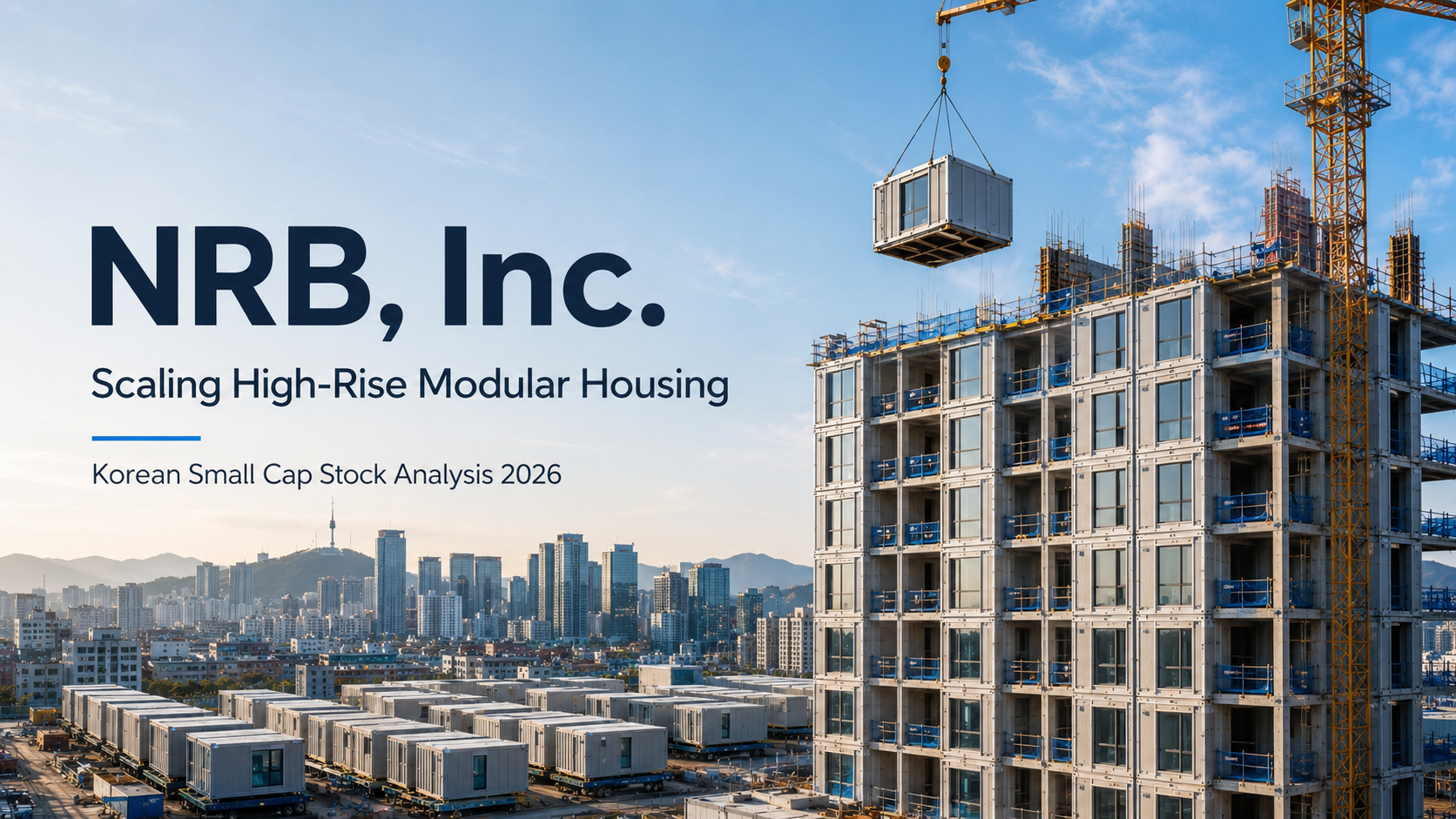
NRB, Inc. (475230.KQ) Stock Analysis 2026: Scaling High-Rise Modular Housing
Executive Summary:
- NRB, Inc. is transitioning from education-focused modular rentals toward high-rise PC modular housing, but the financial benefits of that transition have not yet been fully demonstrated—2025 operating margin compressed to 7.6% (KRW 4.5B operating profit) and net income turned to a KRW 0.5B loss.
- Annual operating margin declined across the three fiscal years from 2023 to 2025 (23.6% → 11.8% → 7.6%), representing two consecutive annual declines, while 2026Q1 recorded an 8.5% margin—an early stabilization signal rather than a confirmed structural recovery.
- Order backlog reached KRW 145.0 billion at the end of 2026Q1, with residential (apartment) modular projects accounting for 87.9%—a material shift from the historically education-focused revenue base.
- Over the five quarters spanning 2025 through 2026Q1, capital investment in property and equipment totaled roughly KRW 80.3 billion, including the new Gunsan factory acquisition of about KRW 36.0 billion in 2026Q1.
- Key risk in one line: Utilization of the newly expanded capacity and cost absorption at the operating level must catch up with the pre-invested cost base before free cash flow can turn positive.
Investment View in One Line
NRB, Inc. is building a repeatable high-rise PC modular platform anchored by the Uiwang-Chopyeong A-4BL reference project, but with margins compressed and CAPEX front-loaded, the investment case hinges on whether project execution and new-plant utilization translate into recovering profit and cash flow through 2026-2027.
Why This Korean Stock Matters
NRB, Inc. is one of the few listed Korean companies with an active reference project in high-rise PC (precast concrete) modular apartment housing. The company is the core modular manufacturer on the Korea Land & Housing Corporation (LH) Uiwang-Chopyeong A-4BL project, a 22-story, 381-unit public housing development incorporating high-rise modular construction, scheduled for completion in July 2027—one of the tallest modular residential projects in Korea. It has also signed a KRW 83.66 billion business agreement with the Dongbu Construction consortium for modular fabrication at the Hanam-Gyosan A1BL project sponsored by Gyeonggi Housing & Urban Development Corporation (GH), a 723-unit development planned at up to 25 stories, with approximately 400 units expected to use modular construction. The agreement designates NRB as the intended contracting or subcontracting party, but the final contract value, scope and schedule may still change as the project moves from the business-agreement stage to execution of the final construction contract.
The company’s financial pattern is consistent with a manufacturing scale-up that has not yet translated into meaningful financial returns. Revenue rose to KRW 59.5 billion (USD 40.7M) in 2025, but operating profit fell to KRW 4.5B and operating margin compressed to 7.6%. Net income turned to a KRW 0.5B loss, and simple free cash flow was deeply negative at roughly KRW –36.3B due to KRW 39.3B of capital investment. In plain terms, the business is investing ahead of cash returns—so valuation and sentiment hinge on whether utilization climbs fast enough to turn operating stabilization into sustainable cash flow.
The order backlog gives the strongest evidence that the business mix is genuinely shifting. At the end of 2026Q1, backlog stood at KRW 145.0 billion, of which residential modular projects made up 87.9%. That is a sharp departure from 2025 actual revenue, where educational facilities still accounted for approximately 86.8% and residential only 12.9%. The current revenue base remains supported by education facilities and modular rentals, while the future backlog has already shifted toward apartment projects.
Core Investment Thesis
1. High-rise modular reference: Uiwang-Chopyeong A-4BL as a qualifying credential
NRB is executing the 22-story, 381-unit LH Uiwang-Chopyeong A-4BL as the core modular fabricator. Total contract value is approximately KRW 90 billion; cumulative revenue recognized through 2026Q1 was about KRW 16.1B, with roughly KRW 73.9B still remaining in the contract balance. Successful delivery through the July 2027 completion date could become a meaningful qualification reference for follow-on public housing tenders, rather than a one-off project.
2. Backlog mix has already shifted—actual revenue mix is likely to follow with a lag
At the end of 2026Q1, total backlog of KRW 145.0 billion was 87.9% residential. However, 2025 realized revenue remained roughly 86.8% education-facility driven. Revenue is recognized by percentage-of-completion rather than in a single delivery, so a transition period is expected in which education facilities and modular rental revenue support the current revenue base while the apartment pipeline builds up.
3. Integrated modular production belt: operating leverage conditional on utilization
The company has assembled a ~74,000-pyeong (~24.5-hectare) production belt across Gunsan and Gimje, covering PC framing, key components, and final assembly. If throughput rises, fixed costs from automation and the newly acquired Gunsan plant would spread across more modules and support operating leverage. Reported utilization was 21.4% in 2024 and 21.8% in 2025, but this figure is calculated on the legacy steel-modular school product line and does not fully capture the new PC-modular apartment capacity being built up. The production belt expands NRB’s control over critical processes, but it should not be interpreted as complete internalization, as external processing and specialist subcontracting remain material parts of the production workflow.
4. Sub-book valuation, but cash flow remains the test
2025 operating profit was positive (KRW 4.5B) but net income was slightly negative (KRW –0.5B), and simple FCF was around KRW –36.3B due to CAPEX of KRW 39.3B. The 2026Q1 net loss of KRW 3.2B was driven largely by finance costs of KRW 5.6B, including approximately KRW 4.5B of derivative valuation losses associated with convertible-bond accounting, rather than by a deterioration in operating profit. That distinction between operating and non-operating dynamics is the crux of the investment case.
Business Model Explained
NRB, Inc. sits in modular construction workflows built around steel and PC (precast concrete) modular structures. NRB fabricates structural modules and key components under factory-controlled conditions, while the degree of factory completion varies by project. On-site work includes transportation, assembly, structural connection and project-specific finishing. The company’s competitive advantage rests on certified structural connections and repeatable fabrication, rather than on 100% factory-completed housing units.
Revenue is generated across four main categories, with a small amount of other revenue: rental (roughly 41.3% of 2025 revenue, mostly education and public facilities), product sales (24.9%), services (20.6%), and construction (12.9%). Rental revenue helps diversify revenue timing, while revenue from products, services and construction remains more sensitive to project execution schedules.
The composition of raw material purchases has shifted materially. PC-related raw materials accounted for 4.82% of total raw-material purchases in 2023, rising to 62.91% in 2025—an approximately 13-fold increase and a 58.1 percentage-point rise. This is a purchase-mix indicator (not a revenue mix), but it corroborates the operational build-up toward high-rise PC apartment modules.
Revenue & Margin Snapshot
| Item | 2023 | 2024 | 2025 |
|---|---|---|---|
| Revenue | 51.5 (35.2) | 52.8 (36.1) | 59.5 (40.7) |
| Op. Profit | 12.1 (8.3) | 6.2 (4.3) | 4.5 (3.1) |
| Op. Margin | 23.6% | 11.8% | 7.6% |
| Net Income | 1.5 (1.0) | 2.0 (1.4) | -0.5 (-0.4) |
| OCF | -19.1 (-13.1) | 20.1 (13.7) | 3.0 (2.1) |
| CAPEX | 7.3 (5.0) | 25.9 (17.7) | 39.3 (26.8) |
| ROE | n/a | n/a | -0.6% |
* Consolidated basis. CAPEX represents cash outflow for acquisition of property, plant and equipment from the cash flow statement, and includes both production capacity investment and additions to rental modular assets. USD translations use KRW 1,463 per USD as of July 28, 2026; financial statements are originally reported in Korean won. Parentheses denote USD translations; negative figures are shown with a minus sign.
Annual trend
▶ Annual Revenue, Operating Profit and Operating Margin (2023–2025, USD M)

| Quarter | Revenue | Op. Profit | Op. Margin | Net Income |
|---|---|---|---|---|
| 2026Q1 | 17.2 (11.7) | 1.5 (1.0) | 8.5% | -3.2 (-2.2) |
| 2025Q4* | 25.8 (17.6) | 0.7 (0.5) | 2.8% | 0.3 (0.2) |
| 2025Q3 | 10.9 (7.5) | 2.2 (1.5) | 20.0% | 2.3 (1.6) |
* NRB listed on KOSDAQ in July 2025. Pre-listing 2025 first-half results were disclosed only on a six-month cumulative basis and are excluded from this quarterly table for axis consistency (for reference: 2025 first-half revenue was KRW 22.8B / USD 15.6M with operating profit of KRW 1.6B / USD 1.1M). Quarterly disclosure began in Q3.
* 2025Q4 figures are calculated by subtracting cumulative 2025Q3 results from full-year 2025 consolidated results.
Quarterly trend
▶ Quarterly Revenue, Operating Profit and Operating Margin (USD M)

In 2025, the company delivered KRW 59.5 billion (USD 40.7M) in revenue, but operating profit of KRW 4.5B translated into a 7.6% operating margin, following 23.6% in 2023 and 11.8% in 2024—two consecutive annual declines. Net income was slightly negative at KRW –0.5B, and simple free cash flow was approximately KRW –36.3B (USD –24.7M) because CAPEX of KRW 39.3B far outpaced the KRW 3.0B of operating cash flow.
Key takeaway from the financial trend
Revenue continues to grow, but operating margin fell from 23.6% in 2023 to 11.8% in 2024 and 7.6% in 2025. The 2026Q1 operating margin of 8.5% is an early stabilization signal, not a confirmed structural recovery. The next test is whether new-plant utilization converts operating stabilization into improved cash flow.
What’s Driving the Numbers
The most important “why” is the mismatch between operating stabilization and cash conversion. In 2025, operating profit of KRW 4.5B stood alongside CAPEX of KRW 39.3B and simple FCF of roughly KRW –36.3B—consistent with a platform build-out phase in which factories, equipment, and rental modular assets are paid for early, while margin benefits depend on project flow and utilization catching up. The 2025 CAPEX figure combines production-capacity investment with additions to rental modular assets (reclassified into investing cash outflows), so interpreting it purely as factory build-out would overstate one component.
The 2026Q1 update reinforces the pattern rather than resolving it. Operating cash flow improved to KRW 9.1B (USD 6.2M), but that included roughly KRW 10.4B of contract liability increases and other working-capital effects, so the pure operating contribution was smaller. Property and equipment acquisitions of KRW 40.9B were dominated by the Gunsan (Osikdo-dong) plant acquisition of approximately KRW 36.0B, funded in part through new long-term borrowings of about KRW 30.0B. Cumulative CAPEX across 2025 and 2026Q1 (five quarters) totaled roughly KRW 80.3 billion (USD 54.9M).
On valuation, the market is pricing in uncertainty about how fast the pre-invested capacity converts into earnings and cash. As of the July 29, 2026 close of KRW 5,800 per share, market capitalization was approximately KRW 63.2 billion (USD 43.2M). Applying the post-April share count to 2026Q1 consolidated equity produces an adjusted BPS of approximately KRW 8,215 and a PBR of roughly 0.71x. Reported net income was negative in 2025, so a trailing PER is not meaningful. The sub-book valuation reflects the enlarged asset base created by recent investment, but also the market’s caution over rising leverage, weak ROE and uncertain cash conversion.
Recent Quarterly Performance
2026Q1 delivered revenue of KRW 17.2 billion (USD 11.7M) with an 8.5% operating margin, but net income landed at KRW –3.2B (USD –2.2M). The gap between operating and bottom-line performance is well documented in the quarterly filing: finance costs totaled approximately KRW 5.6B, including KRW 4.5B of derivative valuation losses primarily associated with convertible-bond accounting—these were the main drivers of the net loss, rather than a deterioration in operating profit.
Prior quarters have also been swingy. 2025Q3 delivered a 20.0% operating margin with net income of KRW 2.3B (USD 1.6M), while the derived 2025Q4 figures show a compressed 2.8% margin with modest positive net income of KRW 0.3B. Full-year 2025 net income was slightly negative at KRW –0.5B despite KRW 4.5 billion of annual operating profit. The takeaway is that operating execution is working intermittently, but translation into earnings and cash remains inconsistent during the transition and ramp-up phase—the type of volatility that can weigh on the share price until the manufacturing-to-installation pipeline stabilizes across multiple projects.
Industry Context & Competitive Position
Korean modular construction demand benefits from policy tailwinds via LH and GH’s Off-Site Construction (OSC) roadmaps and Ministry of Land, Infrastructure and Transport R&D programs targeting standardization and high-rise capability. Industry reports in March 2026 indicated that LH was planning approximately 2,076 modular apartment units across three districts (Pocheon Song-U 2 A1BL 754 units, Goyang Chang-neung A3BL 822 units, Namyangju Wangsuk 2 A10BL 500 units), roughly double the ~1,000-unit plan from the prior year, although fabricator selection schedules have not been finalized.
Within this environment, NRB’s competitive positioning rests on two elements: certified high-rise structural connection technology (Standards Compliance Certification No. 2024-006, KCIC 25-003, No. 2026-001) and an integrated production belt covering PC framing, components, and final assembly. When large general contractors take on public modular apartments as consortium leaders or main contractors, they tend to bring in specialist fabricators like NRB as production partners—the Hanam-Gyosan A1BL business agreement with Dongbu Construction is a recent example of that structure.
| Company | Type | Modular positioning |
|---|---|---|
| NRB, Inc. | Specialist modular fabricator | Certified high-rise PC modular connections; core fabricator on LH Uiwang-Chopyeong A-4BL (22-story, 381 units) |
| XiGEIST (GS E&C subsidiary) | Large contractor subsidiary | Timber prefab / modular housing focused on low-rise premium segment |
| Kumkang Kind | Steel & modular specialist | Steel modular manufacturing with public tender participation history |
| Kyeryong Construction Industrial | Mid-cap contractor | Public housing and military facility modular execution |
| Yoochang E&C | Modular specialist | Steel-based and concrete modular addressing schools, military, dormitories, and apartment projects |
* Qualitative positioning table; modular-segment revenue is not consistently disclosed across peers. Large contractors such as Daewoo E&C, Dongbu Construction and Hyundai Engineering typically participate as consortium leaders or main contractors rather than direct competitors to specialist fabricators.
Balance Sheet & Funding Risk
2025 cash flow gives the clearest read: operating cash flow of KRW 3.0B (USD 2.1M) fell far short of CAPEX at KRW 39.3B (USD 26.8M), producing a large FCF deficit. That does not automatically imply financial distress—modular manufacturers commonly front-load capacity investment—but it does mean project execution and utilization must improve for future CAPEX to be funded more comfortably through operating cash rather than new borrowing. 2026Q1 illustrates the ongoing tension: operating cash flow of KRW 9.1B alongside CAPEX of KRW 40.9B (largely the Gunsan plant acquisition), funded in part through new long-term debt of about KRW 30.0B.
| Period | OCF | CAPEX | Simple FCF | ROE |
|---|---|---|---|---|
| 2023 | -19.1 | 7.3 | -26.4 | n/a |
| 2024 | 20.1 | 25.9 | -5.9 | n/a |
| 2025 | 3.0 | 39.3 | -36.3 | -0.6% |
| 2026Q1 | 9.1 | 40.9 | -31.9 | n/m |
* Simple FCF = OCF – acquisition of property, plant and equipment. Negative figures are shown with a minus sign. 2026Q1 OCF includes approximately KRW 10.4B of contract liability increases and other working-capital effects. n/a for periods where consolidated ROE is not comparably available; n/m for quarterly ROE.
Valuation Perspective
As of the July 29, 2026 KOSDAQ close of KRW 5,800 per share, NRB, Inc. had a market capitalization of approximately KRW 63.2 billion (USD 43.2M at KRW 1,463 per USD). Trailing PER is not meaningful because 2025 net income was slightly negative. Applying the post-April share count (following stock-option exercises in April) to 2026Q1 consolidated equity produces an adjusted BPS of approximately KRW 8,215 per share and a PBR of roughly 0.71x. The sub-book valuation reflects the enlarged asset base created by recent investment, but also the market’s caution over rising leverage, weak ROE and uncertain cash conversion through the CAPEX cycle.
A sub-book multiple alone is not a sufficient basis to conclude that the stock is cheap: book equity includes plant, land and revaluation-related components, ROE is negative, and long-term debt has increased in 2026Q1. The share price is also volatile relative to news flow around fabricator selections and order transitions, so any valuation reference date should be treated as a snapshot rather than a settled anchor.
Peers in this segment typically trade across a wide range depending on backlog quality, contract mix and margin stability, but the market generally penalizes companies that need sustained CAPEX before cash flows normalize.
Key Risks
Investment Considerations: 1) A sustained re-rating is more likely once investors gain confidence that backlog is converting into not just operating profit, but also reliable cash generation; the timing can be longer than bulls hope. 2) Potential dilution from outstanding stock options and convertible bonds should also be monitored as the share price recovers—total potential shares were approximately 1.66 million as of the end of 2026Q1 (about 15.4% of shares outstanding at that time), with about 72,388 options exercised in April 2026. 3) Even with operating momentum, market perception can lag operational improvements, creating volatility that can persist through multiple quarters.
1. Margin compression trend and single-project reference dependency
Operating margin compressed from 23.6% (2023) to 11.8% (2024) and 7.6% (2025), and the 2026Q1 8.5% figure is a one-quarter data point. Cost overruns on the Uiwang-Chopyeong A-4BL project—total estimated costs were revised up by about KRW 1.87B in 2026Q1, with roughly KRW 0.45B of negative earnings impact recognized—demonstrate that high-rise PC cost control is still being proven.
2. Front-loaded CAPEX and financing burden
Cumulative CAPEX across 2025 and 2026Q1 was roughly KRW 80.3 billion (USD 54.9M), including the Gunsan plant acquisition of about KRW 36.0B. If tender awards or construction starts slip, depreciation, interest expense and fixed overhead will hit the P&L before revenue catches up.
3. Policy-to-award timing gap
LH’s 2026 plan for approximately 2,076 modular units is a target rather than a set of finalized contracts. Site selection, permitting, tendering, consortium formation, fabricator selection and final award contracts are separate steps, and Hanam-Gyosan remains at the business-agreement stage. Disclosure timing may lag investor expectations.
4. Potential dilution from stock options and convertible bonds
Total potential shares (stock options plus convertible-bond related) were approximately 1.66 million at the end of 2026Q1, equivalent to about 15.4% of shares outstanding at that time. About 72,388 options were exercised in April 2026, leaving roughly 1.59 million potential shares (approximately 14.6% of the current share count). This is a gross potential share count rather than an estimate of immediate dilution, as the options have different exercise prices, vesting schedules and exercise periods. Actual dilution depends on exercise prices, conversion prices and the share price path; some potential shares were excluded from 2025 diluted EPS as anti-dilutive.
What to Watch Next
- Whether 2026Q1’s 8.5% operating margin is sustained across the following two to three quarters and reverses the multi-year margin compression.
- Whether operating cash flow’s core operating contribution rises and CAPEX moderates, so that free cash flow moves toward less-negative territory.
- Hanam-Gyosan A1BL transition from business agreement to final award contract, including contract value, schedule and scope.
- Fabricator selections for the LH 2026 pipeline (Pocheon Song-U 2, Goyang Chang-neung, Namyangju Wangsuk 2).
- Utilization trajectory of the newly acquired Gunsan plant and integration into disclosed utilization metrics.
FAQ
QWhat is the core investment theme behind NRB, Inc.?
The core theme is scaling repeatable, certified PC/OSC modular execution for high-rise apartments. Revenue is growing and the backlog has shifted to residential (87.9% at end-2026Q1), but operating margin has declined across the three fiscal years from 2023 to 2025 and heavy CAPEX has been front-loaded. The next validation is whether new capacity and the Uiwang-Chopyeong reference translate into recovering margin and cash generation.
QDid NRB’s profitability recover in 2025?
No. Revenue grew to KRW 59.5 billion (USD 40.7M) in 2025, but operating profit fell to KRW 4.5B and operating margin compressed to 7.6%, following 23.6% in 2023 and 11.8% in 2024—two consecutive annual declines. Net income turned to a slight loss of KRW –0.5B. The 2026Q1 8.5% operating margin is an early stabilization signal, not confirmation of a structural recovery.
QIs the negative free cash flow a structural problem or a timing issue?
The current FCF deficit appears to be driven primarily by front-loaded capacity investment rather than an absence of backlog. 2025 OCF was positive at KRW 3.0B while CAPEX reached KRW 39.3B; 2026Q1 OCF improved to KRW 9.1B against CAPEX of KRW 40.9B. Cumulative CAPEX across five quarters was about KRW 80.3 billion. Whether it remains a timing issue depends on utilization, project margins and future borrowing requirements.
QWhat caused the 2026Q1 net loss despite an 8.5% operating margin?
The KRW 3.2B net loss in 2026Q1 was driven largely by KRW 5.6B of finance costs, which included approximately KRW 4.5B of derivative valuation losses primarily associated with convertible-bond accounting. NRB remained profitable at the operating level, reporting KRW 1.5B of operating profit despite the bottom-line loss.
QWhy is PBR at roughly 0.71x relevant when PER is not meaningful?
When trailing net income is negative, PER becomes not meaningful and the share price is anchored more tightly to balance-sheet expectations. A PBR below 1.0x can indicate investor doubt about near-term profitability durability and cash conversion. However, book equity includes plant, land and revaluation components, so a sub-1.0x PBR alone is not sufficient to conclude the stock is cheap.
QWhat is the main operational milestone to watch?
The Uiwang-Chopyeong A-4BL project (22 stories, 381 units, KRW 90B total contract) is scheduled for completion in July 2027 and is the reference credential for follow-on LH tenders. Watch for milestones in factory fabrication and on-site installation, along with cost variance updates, before the Hanam-Gyosan A1BL final contract and 2026 LH fabricator selections.
Disclaimer
This material is provided for informational purposes only and does not constitute a solicitation or recommendation to buy or sell any security. All figures, projections, and analyses are based on publicly available information and may differ from actual results; they are subject to change without notice. The reader bears full responsibility for any investment decisions made. The author accepts no legal liability for any investment outcome arising from reliance on this material. All investment decisions should be made at the reader’s own discretion and risk. Independent professional investment advice should be sought where appropriate.
Visit NRB’s official website at https://www.and-rb.com for more information.
For more Korean small-cap ideas, visit our Korean Small Cap Stocks section.
You can also read our Industry Analysis articles.
You can get more detail information in this article ->https://hanalpha.substack.com/publish/post/209050950