
Executive Summary:
- Osang Healthcare already proved it can swing from a hard profit collapse in 2024 to an operating rebound in 2025, but the quality of that recovery still hinges on whether the core U.S.-linked COVID/flu combo franchise sustains demand without margin dilution (2024 Revenue: ~54 USD M; 2025 Revenue: ~87 USD M, and 2025 Op. Margin: 1.9%).
- The business has a “two-speed” profile: earlier years showed exceptional profitability (e.g., 2023 Op. Margin: 40.1%), yet the 2024 drawdown was deep enough to flip operating income to a loss (~-17 USD M), meaning investors should treat the 2025 turnaround as a process, not a finished restructuring.
- Industry dynamics for IVD are cycle-driven, and Osang Healthcare’s outcomes have tracked that reality—immuno and infection-related demand can fall quickly, then reappear when variants and procurement cycles restart. Competition is also intensifying, with multiple new combo-kit entrants gaining FDA approval in the U.S. market during 2025.
- What matters now is the next confirmation of margin resilience: not just sales growth, but whether the cost base and product mix stop eroding profitability as volumes normalize.
- Key risk in one line: revenue concentration around a small set of influential buyers and product formats can pull earnings around faster than investors expect.
Investment View in One Line
The stock’s turnaround narrative looks real in the numbers, but the market will only keep paying for it if the next procurement cycle extends margins—not merely revenue.
Why This Stock Matters
Osang Healthcare sits in the kind of IVD subsector where the product is technical, but the financial trajectory is often determined by procurement timing and disease-wave demand. The reason this Korean small-cap diagnostics name draws attention is not that it has “future optionality” in general—it is that management’s recent execution has already translated into a measurable profitability rebound after a severe 2024 reset. When you read the full financial arc, the business looks like a platform company that can look great in one cycle and painful in the next unless demand durability is proven.
That same tension explains why the market’s patience can run out quickly. In 2024, operating losses emerged despite the company’s earlier history of high profitability; in 2025, the company returned to operating profit but with a thin margin, which tells you the cost structure and mix are still being stress-tested. This is the difference between a rebound and a foundation.
Core Investment Thesis
1. Financial buffering matters more than optimism in a cyclical IVD name
Management’s turnaround credibility starts with staying power: the balance sheet is strong enough to absorb volatility without forcing equity dilution or abrupt cost cutting. In a business where revenue can swing sharply when immuno/infection demand moves, that balance-sheet cushion is the difference between a temporary dip and a permanent impairment of the growth plan.
2. The 2025 recovery is real, and it is tied to a U.S.-facing combo-kit engine
The core logic is simple: the company moved from a 2024 operating loss (~-17 USD M) to a 2025 operating profit (~2 USD M). Management’s explanation centers on the COVID/flu combo-kit supply to a major global medical device company (reportedly Abbott, based on FDA registration records). The kit received FDA 510(k) clearance in January 2025—a world-first for a professional/consumer combo rapid test—and multi-year exclusive supply arrangements are in place. However, competition is intensifying: multiple other manufacturers gained FDA approval for similar combo kits during 2025, which the company itself acknowledged as a factor in its weaker 2025Q3 results.
3. CGM is optionality, not the current earnings engine
Osang Healthcare invested approximately USD 40 million in Allez Health, a U.S.-based CGM developer founded by ex-Dexcom engineers, acquiring a ~25–27% stake and becoming its largest shareholder. The company originally targeted 2026 FDA approval for the iCGM product, but revised its regulatory strategy in late 2025 to pursue simultaneous approvals in the U.S., Europe, and Korea, pushing the expected commercial launch to 2027. Until regulatory milestones translate into scalable revenue, the market will keep assigning most of the valuation weight to near-term diagnostics cash flows.
Business Model Explained
Osang Healthcare operates in IVD diagnostics with a multi-technology portfolio that includes biochemistry (blood glucose meters, HbA1c analyzers, cholesterol meters), immunoassay (SelexOn platform, COVID-19/flu rapid test kits), and molecular testing (Real-Time PCR for HLA/HPV/STD/TB and tropical diseases). The core commercial reality is that customers buy tests that solve urgent clinical needs “now,” so the revenue pattern tends to follow disease-wave behavior and procurement cycles rather than stable subscription economics. That said, the company’s POCT-centered orientation (especially repeatable formats like strips or cartridge-like consumables) can moderate volatility relative to purely one-time products.
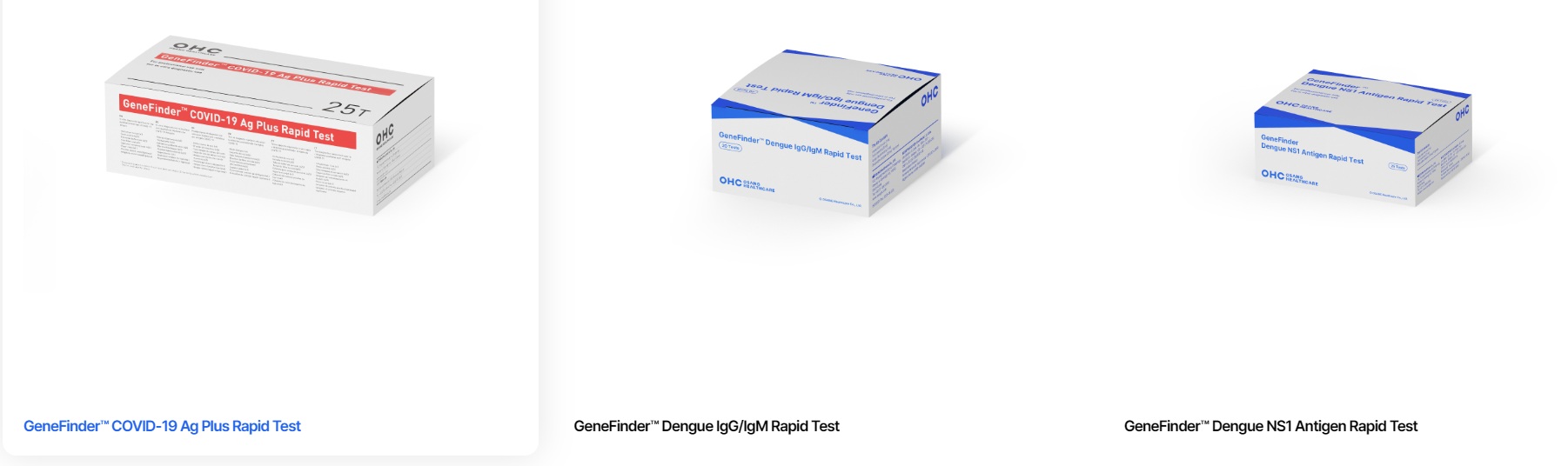
Revenue is split roughly 57% biochemistry (primarily blood glucose), 39% immunoassay (including combo kits), and the remainder in molecular diagnostics and other products (based on 2025 annual report product-level disclosure; note that sub-product breakdowns within the biochemistry segment cause the stated percentages to sum above 100%). Emerging areas—like CGM—should be treated as optionality layered on top of the current diagnostics business, not as the reason earnings are happening today.
Revenue & Margin Snapshot
※ USD figures are approximate, converted at ~1,480 KRW/USD for reference. Original financials are reported in KRW.
| Item | 2022 | 2023 | 2024 | 2025 |
|---|---|---|---|---|
| Revenue | 131 | 241 | 54 | 87 |
| Op. Profit | 33 | 97 | -17 | 2 |
| Op. Margin | 25.4% | 40.1% | -30.8% | 1.9% |
| Net Income | 28 | 79 | -8 | 2 |
| OCF | 29 | 103 | -26 | 4 |
| CAPEX | 8 | 24 | 6 | 11 |
| ROE | 20.3% | 39.8% | -4.0% | 1.1% |
Revenue trend (annual)
▶ Revenue & Operating Profit Trend

The headline story in the revenue history is not smooth growth; it is a cycle-driven sawtooth. A sharp spike in 2020 and strong profitability in 2023 were followed by a severe contraction in 2024, and then a partial normalization in 2025.
Key takeaway from the financial trend
The 2025 turnaround is visible, but the margin level indicates the business is still rebuilding earnings durability rather than returning to the high-profit structure seen in the last strong cycle.
What’s Driving the Numbers
Revenue direction looks like a procurement-and-variant story rather than organic, steady demand. The scale jump from 2024 to 2025 aligns with infection-wave related test demand and supply timing, while the return to operating profit suggests the company successfully navigated the shift in mix. However, the quarterly swing in 2025—profitability in mid-year quarters contrasted with a loss in 2025Q4—signals that the company’s earnings are still highly exposed to how quickly large orders land and how costs scale with that volume.
The balance sheet remains strong: total assets of ~227 USD M, liabilities of ~37 USD M, and equity of ~190 USD M as of year-end 2025, with a debt ratio of 19.5%. Subsidiary and associate investment assets of approximately ~57 USD M provide additional cushion. This financial resilience is a meaningful advantage in a cyclical IVD business where cash burn during product transitions is common.
Recent Quarterly Performance
| Quarter | Revenue | Op. Profit | Op. Margin | Net Income |
|---|---|---|---|---|
| 2025Q4 | 20 | -2 | -11.0% | -2 |
| 2025Q3 | 17 | -3 | -19.1% | 3.0 |
| 2025Q2 | 28 | 4 | 15.2% | -0 |
| 2025Q1 | 22 | 3 | 12.7% | 3 |
| 2024Q4 | 13 | -6 | -42.2% | -1 |
| 2024Q3 | 14 | -5 | -35.0% | -4 |
| 2024Q2 | 14 | -3 | -21.9% | -4 |
| 2024Q1 | 14 | -3 | -24.6% | 1 |
The most recent quarters show a business that cannot be characterized as steadily improving. 2025Q1 and 2025Q2 delivered operating profits with positive margin rates, but 2025Q3 turned choppier as revenue fell while operating results deteriorated—partly due to intensifying competition from other FDA-approved combo kits—and 2025Q4 posted a clear operating loss. The pattern matters because it suggests that even if the headline annual numbers look better, execution risk remains in the timing of shipments and in the economics of each wave of demand.
Industry Context & Competitive Position
IVD diagnostics is still fundamentally driven by the clinical need to measure diseases quickly and reliably, but the company’s results show how harshly that can translate into quarterly volatility. Management’s portfolio approach helps diversify technology risk, yet infection-linked immuno and molecular segments can still swing dramatically when a specific variant or policy purchasing cycle changes.
Competition in the U.S. combo-kit market has intensified meaningfully: during 2025, multiple additional manufacturers received FDA approval for COVID/flu rapid tests, and the company acknowledged this as a factor in its weaker 2025Q3 performance. This is a structural risk for the investment case, not just a timing issue.
Recent company updates on COVID-variant diagnostic fit—such as the “Sikada (BA.3.2)” confirmation—reinforce that the company is trying to reduce requalification anxiety for buyers, which is exactly the type of mechanism that can support demand continuity when disease waves are active.
Balance Sheet & Financial Stability
Stability has improved the investment case because diagnostics can burn cash during product transitions, but this company’s capital structure gives it room to keep investing through volatility. In 2025, the operating cash flow turned positive (~4 USD M) while capex rose to ~11 USD M, resulting in a free cash flow deficit of ~-7 USD M. This should be read as investment intensity rather than a pure cash-generation failure, but the pattern needs to reverse for the turnaround narrative to fully hold.
| Year | OCF (USD M) | CAPEX (USD M) | FCF (USD M) | ROE (%) |
|---|---|---|---|---|
| 2022 | 29 | 8 | 30.7 | 20.3% |
| 2023 | 103 | 24 | 116.9 | 39.8% |
| 2024 | -26 | 6 | -47.1 | -4.0% |
| 2025 | 6.2 | 11 | -9.9 | 1.1% |
Valuation Perspective
Valuation multiples fluctuate significantly depending on the reference date for this stock, and readers should verify current figures independently. The key analytical point is that the market is not yet paying for earnings consistency—history includes deep losses and then thin profits, which keeps the earnings “trust” discount alive. In a sector like IVD, the market pays less when earnings quality is still being rebuilt, and the 2025 margin level is not yet strong enough to prove structural resilience.
Key Risks
Investment Considerations: 1) Re-rating timing is uncertain because the company’s turnaround has to demonstrate not just a return to operating profit, but repeatable margin delivery through the next shipment window. 2) CGM regulatory strategy has shifted: the company originally targeted 2026 FDA approval but revised its approach in late 2025 to pursue simultaneous U.S./EU/Korea approvals, pushing the expected launch to 2027. 3) Competition in the U.S. combo-kit market has intensified with additional FDA-approved entrants, which could pressure volumes and pricing.
1. Revenue concentration risk around a limited set of buyers and formats
The largest external customer accounts for approximately 39% of total revenue (~34 USD M). When a material portion of revenue depends on a small number of influential counterparties, procurement timing and contract renewals can swing both topline and margins.
2. Combo-kit competitive intensification
Multiple manufacturers gained FDA approval for COVID/flu combo rapid tests during 2025, and the company itself acknowledged this competition as a factor in its weaker 2025Q3 results. Market share expansion may slow, and pricing pressure could compress margins on what is currently the core growth driver.
3. Cost structure sensitivity during cycle normalization
The company showed that operating losses can reappear when the mix changes or when volume falls faster than fixed costs adjust. With a 2025 operating margin of just 1.9%, small shifts in product mix or pricing can quickly flip quarterly results.
4. CGM timeline risk
The CGM opportunity (via ~USD 40M investment in Allez Health, ~25–27% stake) is real optionality, but the regulatory strategy was revised in late 2025—originally targeting 2026 FDA approval, now targeting 2027 simultaneous launch across U.S., Europe, and Korea. Further delays could erode sentiment in a stock where CGM expectations are partially priced in.
5. FX and borrowing structure
The company disclosed that a 5% USD/KRW move would impact pre-tax income by approximately ~1.1 USD M. With current long-term borrowings of ~22 USD M and FCF still negative at ~-7 USD M, the cash flow profile remains vulnerable to external shocks.
What to Watch Next
- Whether 2026 quarterly profitability holds without another late-year margin relapse
- Evidence that combo-kit related demand is recurring (not one-wave only), with stable gross profit despite increasing competition from other FDA-approved entrants
- Updates on CGM regulatory milestones: FDA IDE filing status, clinical trial progress, and whether the 2027 launch timeline holds
- Any changes in buyer concentration signals, contract terms, or geography mix
- FCF trajectory: whether OCF expansion can outpace capex and flip FCF positive
FAQ
QIs Osang Healthcare a good stock to watch for a turnaround story?
The turnaround attempt is visible in the move from an operating loss in 2024 to operating profit in 2025, which is a concrete change rather than a vague promise. The catch is that the margin recovery is still thin (1.9% operating margin), and competition in the U.S. combo-kit market has intensified. Investors should watch for consistency through the next shipment window.
QWhat drove the jump in revenue from 2024 to 2025?
The pattern fits an infection-wave procurement cycle, with management pointing to COVID/flu combo-kit supply to a major global medical device company (reportedly Abbott, based on FDA registration records) as the key factor. The kit received FDA 510(k) clearance in January 2025. Quarterly results also imply shipment timing effects, so durability depends on whether orders continue to land consistently.
QHow should investors interpret the recent margin profile?
It indicates progress but not a restoration to the high-margin regime seen in the last strong cycle. The quarter-to-quarter swing—including operating losses in 2025Q3 and Q4—suggests cost and mix sensitivity remains, exacerbated by increasing competition in the combo-kit segment.
QWhat is the CGM opportunity and when could it contribute?
Osang Healthcare invested approximately USD 40 million in Allez Health, a U.S.-based CGM developer founded by ex-Dexcom engineers, acquiring a ~25–27% stake. The company originally targeted 2026 FDA approval but revised its strategy in late 2025 to pursue simultaneous approvals in the U.S., Europe, and Korea, with commercial launch now expected in 2027. Until regulatory milestones are achieved, CGM should be treated as optionality, not current earnings.
QWhat is the biggest operational risk?
Revenue and earnings can be pulled around by concentrated buyers (the largest customer accounts for ~39% of revenue (~34 USD M)) and the economics of specific product formats. Additionally, the intensifying competition in the U.S. combo-kit market could pressure both volumes and pricing going forward.
QHow strong is the company’s cash generation after the 2024 downturn?
Cash flow has improved versus 2024 (OCF went from ~-26 USD M to ~+4 USD M), but FCF remains negative at ~-7 USD M due to elevated capex of ~11 USD M. The balance sheet is strong (debt ratio 19.5%, total equity ~190 USD M), which provides cushion, but the cash conversion profile is still rebuilding.
QWhy does the market assign a valuation discount even after the turnaround?
Because history shows that infection-related demand can reverse quickly, and the 2025 margin level is not yet strong enough to prove structural resilience. The market also recognizes that combo-kit competition is intensifying. In a sector like IVD, the market pays less when earnings quality is still being rebuilt.
For more Korean small cap ideas, visit our Korean Small Cap Stocks section.
You can also read our Industry Analysis articles.