
Executive Summary:
- DAP is a Korean PCB manufacturer where the consolidated income statement was distorted for years by losses from its aviation subsidiary Aero K Holdings. On March 31, 2026, DAP disposed of its entire 70.08% controlling stake in Aero K, removing the structural drag on consolidated earnings and capital adequacy.
- On a separate (parent-only) basis, DAP’s PCB business posted operating profit of $7.7M, $2.3M, and $1.3M in 2023-2025 — three consecutive years of profitability — while consolidated operating losses of $8.9M, $20.7M, and $39.4M reflected almost entirely the Aero K aviation losses absorbed in consolidation.
- The 2025 separate net income turned positive at +$5.8M, primarily because the equity-method losses on Aero K were already fully written down, not because of an underlying step-change in PCB economics.
- The real operational question for 2026 onwards is whether separate operating margin (3.16% → 0.97% → 0.59%) stabilizes, given a 67.5% utilization rate (production 666,989 sqm vs capacity 987,678 sqm), rising raw-material costs, and customer concentration above 49%.
- Key risk in one line: DAP must restore PCB segment margins because the consolidated story will lose its convenient “Aero K excuse” from FY2026 onwards.
Investment View in One Line
DAP becomes a clean PCB pure-play in 2026; the equity story shifts from “decode the Aero K accounting” to “did mobile HDI and automotive radar PCB justify the equity premium” — a much simpler thesis to underwrite.
Why This Korean Stock Matters
For three years, DAP’s consolidated financials told one story (deepening losses, capital impairment, KOSDAQ Investment Alert risk) while its separate-basis financials told a fundamentally different story (a profitable, technically capable PCB manufacturer with credible automotive electronics exposure). The discrepancy was almost entirely Aero K Holdings — DAP’s 80.75%-owned aviation subsidiary based in Cheongju, operating Airbus A320-200s under the budget carrier brand Aero K Air. With the 70.08% stake sale completed on March 31, 2026, the two stories converge from FY2026 onwards. Investors who had been pricing DAP for capital-impairment risk now have to re-evaluate it as a Korean mid-cap PCB operator with build-up technology, Samsung mobile HDI exposure, and a 42.89% revenue contribution from automotive electronics including radar PCB for Hyundai Mobis and LG Electronics VS.
Core Investment Thesis
1. Aero K divestment removes the dominant overhang and unmasks PCB economics
DAP’s separate equity remained at $63.4M at year-end 2025 with a 38% equity ratio. The consolidated capital impairment that triggered the KOSDAQ Investment Alert notification was driven entirely by Aero K losses flowing through equity-method accounting and consolidation. Once Aero K is deconsolidated from FY2026, the consolidated balance sheet should converge toward the separate one, and the Investment Alert risk should fade through normal annual review cycles.
2. Automotive PCB is already 42.89% of revenue, with radar PCB as the value driver
DAP supplies automotive PCB primarily to Hyundai Mobis and LG Electronics VS, with AVN (Audio-Video-Navigation) boards as the main volume contributor. Radar PCB has been shipping since late 2019 and uses 77GHz millimeter-wave frequencies, which require low-loss substrates and tighter manufacturing tolerances — characteristics that translate into higher unit pricing and margin contribution than commodity automotive PCB. DAP’s patent portfolio includes vehicle antenna PCB methods (2018) and specialized bonding patterns for automotive electronics (2023).
3. Mobile HDI optionality remains, particularly via Samsung Galaxy and foldable expansion
Mobile and electronics PCB still represented 52.32% of PCB revenue in 2025 ($117M USD). DAP and Korea Circuit have absorbed Samsung’s HDI demand since Samsung Electro-Mechanics exited the HDI business in late 2019. Korean trade press reports indicate DAP and Korea Circuit are tracking to take majority first-vendor share in Galaxy S26 HDI development. The foldable smartphone segment is forecast to grow ~20% in 2026, and Apple’s anticipated foldable entry would expand the addressable market further — both supportive of HDI ASP and volume.
Business Model Explained
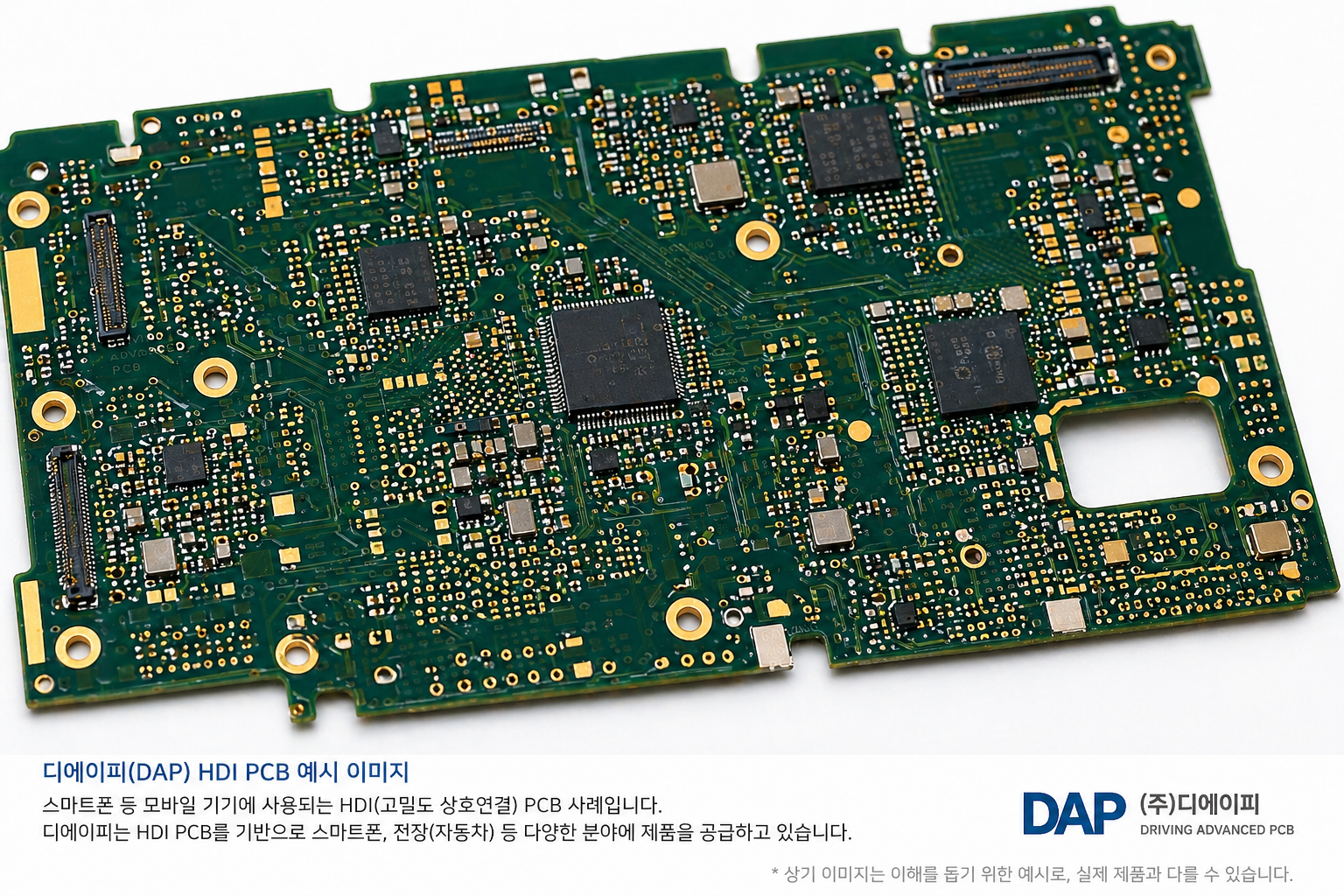
DAP, founded in 1987, manufactures printed circuit boards with a focus on build-up HDI technology — a method of constructing multi-layer PCBs through sequential lamination that enables the high density required by smartphones and complex automotive electronics. The company runs production from a single primary site in Anseong, Gyeonggi Province, with an additional facility in Ansan. The major shareholder is Daemyung Chemical (47.63%). Revenue is heavily skewed to exports (74.4% of sales), and customer concentration is significant: the top two customers accounted for 49.80% of PCB revenue in 2025 (Customer A 30.16%, Customer B 19.64%). Customer B’s share rose meaningfully from 11.63% the prior year, indicating an active program ramp with one specific account.
Annual Financials — Separate (Parent-Only) Basis
The single most important framing in this analysis: read DAP on a separate basis, not consolidated. The separate income statement captures only the PCB manufacturing business; the consolidated income statement was overwhelmed by Aero K aviation losses through 2025.
| Item | FY2023 | FY2024 | FY2025 |
|---|---|---|---|
| Revenue | 243 | 236 | 225 |
| Gross Profit | 15.9 | 10.7 | 9.9 |
| Gross Margin | 6.55% | 4.55% | 4.41% |
| Operating Profit | +7.7 | +2.3 | +1.3 |
| Operating Margin | 3.16% | 0.97% | 0.59% |
| Equity-Method Loss (Aero K) | -9.6 | -1.7 | 0.0 |
| Net Income | -10.9 | -8.8 | +5.8 |
Separate-basis revenue and operating profit trend

Reading the separate-basis trend
PCB operating margin compressed from 3.16% to 0.59% over three years. Revenue declined modestly. The 2025 separate net income turned positive (+$5.8M), but this is largely because the Aero K equity-method loss reached zero (the carrying value was already fully written down by 2024 year-end), not because the PCB business itself improved. The real test is whether 2026 separate margins recover, not whether net income stays positive.
Separate vs Consolidated: Why The Two Statements Diverged
Korean accounting (K-IFRS) requires reporting both separate (parent-only) and consolidated financial statements. For DAP, the two have differed dramatically since Aero K was acquired in August 2022. The separate income statement reflects DAP’s PCB manufacturing only; the consolidated statement adds Aero K’s aviation operations line-by-line. The chart below shows just how large the gap became.
| Year | Separate (PCB only) | Consolidated (incl. Aero K) | Gap = Aero K impact |
|---|---|---|---|
| FY2023 | +$7.7M | -$8.9M | $16.6M |
| FY2024 | +$2.3M | -$20.7M | $23.0M |
| FY2025 | +$1.3M | -$39.4M | $40.7M |

The gap widened every year as Aero K’s aviation losses scaled with route expansion. The fundamental implication: from FY2026 onwards, with Aero K deconsolidated, the consolidated operating line should converge toward the separate one. That alone removes the largest historical reason for negative consolidated headlines.
What’s Driving the Numbers (PCB Segment View)
Within the PCB segment itself, three operational signals warrant close attention. First, gross margin compression. Gross margin fell from 6.55% in 2023 to 4.41% in 2025. The PCB average selling price actually rose 12.4% in 2025 (from 427,958 to 480,832 KRW per square meter), so weak pricing is not the explanation. Cost inputs are: PGC chemicals jumped 62.6% over two years (43,193 KRW to 70,240 KRW per kg), and key raw materials including RCC, dry film, and copper foil saw incremental upward pressure. Cost inflation outran the unit-price increase.
Second, capacity utilization at 67.5%. Production was 666,989 sqm against capacity of 987,678 sqm in 2025. That gap depresses fixed-cost absorption and is one of the cleanest paths to margin recovery — every additional sqm of utilization should drop more directly into operating profit because fixed costs are already in place.
Third, customer concentration intensifying. The top two customers represented 49.80% of revenue in 2025, with Customer B alone rising from 11.63% to 19.64% year-over-year. This is double-edged: it suggests an active program ramp, but it also means a single sourcing decision could cause a meaningful revenue swing. PCB businesses are notoriously sensitive to such customer events because pricing reset usually accompanies share shifts.
Recent Quarterly Performance
Quarterly data is only disclosed on a consolidated basis; Korean issuers typically disclose separate financials only at annual and semi-annual checkpoints. The table and chart below therefore show consolidated quarterly data, with separate annual quarterly average lines overlaid as a reference. The reference line is the cleanest way to visualize how much of each quarter’s reported loss was attributable to Aero K versus PCB economics.
| Quarter | Revenue | Op. Profit | Op. Margin | Reference: Separate quarterly avg |
|---|---|---|---|---|
| 2024Q1 | 83 | +0.7 | +0.8% | FY2024 separate annual +$2.3M (avg +$0.6M/Q) |
| 2024Q2 | 79 | -7.5 | -9.4% | |
| 2024Q3 | 86 | -6.8 | -8.0% | |
| 2024Q4 | 85 | -7.1 | -8.3% | |
| 2025Q1 | 100 | -1.0 | -1.0% | FY2025 separate annual +$1.3M (avg +$0.3M/Q) |
| 2025Q2 | 84 | -13.5 | -16.0% | |
| 2025Q3 | 85 | -20.2 | -23.7% | |
| 2025Q4 | 101 | -4.7 | -4.7% |

The interpretation is direct: Q3 2025’s -$20.2M consolidated operating loss versus a separate quarterly average of +$0.3M implies roughly $20.5M of quarterly Aero K-related loss in that single quarter. The Q4 2025 narrowing to -$4.7M may reflect either operational improvement at Aero K or one-off accounting effects related to the disposal preparation. From Q1 2026, with Aero K deconsolidated, the consolidated operating line should converge to a low-single-digit USD millions per quarter range, consistent with the separate-basis run rate.
Industry Context & Competitive Position
Korean PCB manufacturers compete across several distinct sub-segments: package substrates (FC-BGA, FC-CSP) at the high-margin end, multi-layer boards for AI/networking, HDI for mobile, and rigid PCB for automotive. DAP sits in the “HDI plus automotive PCB” middle tier. The key technical capability is build-up methodology — sequential lamination producing dense, multi-layer boards suitable for both smartphones and complex automotive electronics. The patent portfolio (65+ issued patents) covers process improvements specific to high-density boards and automotive applications, including specialized vehicle antenna PCB methods and bonding compression patterns for automotive electronics.
| Company | Primary Products | Positioning | Competitive Edge |
|---|---|---|---|
| Samsung Electro-Mechanics | MLCC, FC-BGA, semiconductor substrates | Global scale leader | AI/server FC-BGA entry, vertical Samsung integration |
| Isu Petasys | High-layer-count MLB | AI/networking exposure | Nvidia, Cisco supply chain participation |
| Daeduck Electronics | Package substrate, RF, HDI | Substrate + automotive mix | FC-BGA capacity expansion, automotive base |
| Korea Circuit | HDI, package substrate | Direct HDI peer to DAP | Galaxy HDI first-vendor share, foldable readiness |
| DAP (066900.KS) | HDI (mobile) + Automotive PCB | Balanced HDI/automotive mid-cap | Build-up technology, Hyundai Mobis radar PCB, Samsung HDI |
The clearest peer is Korea Circuit — both supply Samsung’s Galaxy HDI under the same first-vendor framework, and both face the same demand cycle. The differentiation point for DAP is the larger automotive electronics share, which provides a separate growth vector independent of mobile cycle timing.
Balance Sheet & Capital Structure
The balance-sheet story splits cleanly between separate and consolidated views, and the difference matters for capital impairment considerations.
| Item | FY2023 | FY2024 | FY2025 |
|---|---|---|---|
| Total Assets | 149.1 | 139.7 | 165.6 |
| Total Liabilities | 75.0 | 76.2 | 102.2 |
| Total Equity | 74.1 | 63.5 | 63.4 |
| Short-term Borrowings | 22.8 | 26.4 | 50.5 |
| Cash & Equivalents | 8.5 | 6.3 | 6.6 |
| Loans to Related Parties (Aero K) | 0.0 | 0.0 | 19.9 |
Three points stand out. First, separate equity remained stable at $63.4M with a healthy 38% equity ratio — there is no separate-basis capital impairment. Second, short-term borrowings nearly doubled in 2025 ($26.4M → $50.5M), and at the same time DAP extended $19.9M in new related-party loans to Aero K. The simplest interpretation is that DAP raised debt at the parent level to fund Aero K’s working capital. With Aero K divested, this funding rationale disappears, and 2026 should see borrowing levels normalize. Third, the related-party loans of $19.9M and the contingent liabilities tied to Aero K (including a litigation-related guarantee of approximately $8.2M for an aircraft delivery dispute) are residual exposures that need to be resolved or written off depending on the disposal terms.
Korean Exchange Context: KOSDAQ Investment Alert
DAP disclosed in its 2025 annual report that the Korea Exchange (KRX) had notified the company of potential designation as an “Investment Alert” issuer (관리종목, an intermediate KOSDAQ status before delisting review). The triggers cited were: consolidated capital impairment exceeding 50%, and pre-tax operating losses (exceeding 50% of equity) in two of the three most recent fiscal years. Both triggers stem from consolidated-basis figures, not separate. With Aero K deconsolidated from FY2026, the 2026 annual review should not produce the same triggers — separate equity is healthy and separate operating profit is positive — but the formal removal of the alert risk requires the actual FY2026 consolidated audit to be filed in early 2027. Equity holders should monitor the Q4 2026 and FY2026 disclosures for confirmation.
Valuation Perspective
Several frequently cited multiples for DAP — most notably ROE 311.9% and consolidated PBR around 11x — are mathematical artifacts of consolidated capital impairment (very small denominators). They are not interpretable as health signals. The cleaner valuation lens is separate-basis:
- Separate ROE (FY2025): approximately 9.1% based on net income of $5.8M and average equity of $63.5M — though this number is itself inflated by the one-time disappearance of equity-method losses. Underlying operating ROA is in the low single digits given the 0.59% operating margin.
- Separate PBR: approximately 0.33x at recent market cap relative to separate book value. This is at the lower end of the company’s historical range.
- EV/Sales: approximately 0.2-0.3x on separate revenue, consistent with a mid-cap PCB operator with modest margins but a credible technology base.
The valuation re-rating thesis depends on three things converging in 2026: consolidated operating line normalizing toward separate (mechanical, expected); KOSDAQ Investment Alert risk being formally removed (process-dependent); and PCB operating margin recovering from the 0.59% trough (operationally uncertain). The first two are largely structural; the third determines whether multiple expansion is justified.
Key Risks
PCB margin recovery is uncertain
Separate operating margin compressed from 3.16% to 0.59% over three years, driven by raw-material cost inflation (PGC chemicals +62.6%) and capacity utilization at 67.5%. Even with Aero K removed, if PCB-only margins do not recover, the consolidated picture will not look meaningfully better than current separate figures — and the equity story loses its core upside catalyst.
Customer concentration intensifying
Top two customers account for 49.80% of PCB revenue, with Customer B’s share rising sharply from 11.63% to 19.64% in one year. Any change in sourcing decisions, pricing pressure, or program timing from these accounts could move revenue and utilization meaningfully. PCB businesses tend to absorb such impacts in margin first, revenue second.
Aero K residual exposures and disposal-related charges
Even after the 70.08% stake sale, residual exposures remain: $19.9M of related-party loans to Aero K entities, contingent liabilities including approximately $8.2M of guarantees related to an aircraft delivery dispute, and uncertainty about disposal terms. Recovery rates and any one-time charges related to the divestment will be reflected in 2026 financials and need monitoring.
FX and raw-material exposure
Exports represent 74.4% of revenue with substantial USD billing, while many key inputs are USD-denominated. The 2025 disclosure indicates a 10% USD movement would shift consolidated pre-tax results by roughly $9-10M — significant relative to current operating profit levels. Raw-material price moves, especially for chemicals and copper-related inputs, have shown they can outrun selling-price negotiations.
What to Watch Next
- FY2026 consolidated quarterly results converging to the separate-basis run rate (low single-digit USD M per quarter).
- Removal of KOSDAQ Investment Alert designation following the FY2026 audit filing.
- Capacity utilization trending from 67.5% toward higher levels, signaling fixed-cost absorption recovery.
- Repayment or write-off treatment of the $19.9M related-party loans to Aero K, and resolution of contingent liabilities.
- Galaxy S26 HDI first-vendor confirmation and any disclosure of automotive radar PCB volume momentum into Hyundai Mobis programs.
- Short-term borrowings normalizing back toward 2024 levels as the Aero K funding need disappears.
FAQ
QWhat does DAP actually do, after the Aero K divestment?
DAP is a Korean printed circuit board (PCB) manufacturer focused on build-up HDI technology. After the March 31, 2026 disposal of its 70.08% stake in Aero K Holdings, DAP is effectively a PCB pure-play. PCB revenue splits roughly 52% mobile/electronics HDI and 43% automotive PCB, with the remainder being byproduct sales.
QWhy did consolidated and separate numbers differ so much?
Consolidated financials added Aero K aviation losses to DAP’s PCB results. In FY2025, consolidated operating loss was -$39.4M; separate (PCB only) operating profit was +$1.3M. The $40.7M gap was almost entirely Aero K. Going forward, with Aero K deconsolidated, the two views should converge.
QWhy is the 2025 separate net income positive while operating profit is small?
Operating profit was $1.3M, but net income was $5.8M, bridged by other income (mainly the disappearance of equity-method losses on Aero K — those reached zero in 2025 because the carrying value was already fully impaired). The positive net income should not be read as PCB business strength; it reflects a one-time accounting transition.
QHow serious is the KOSDAQ Investment Alert risk?
It was a real risk under FY2025 consolidated metrics. With Aero K deconsolidated from FY2026, the underlying triggers (consolidated capital impairment, recurring pre-tax losses) should not recur — separate equity is healthy at $63.4M and separate operating profit is positive. Formal removal will be confirmed only with the FY2026 audit filing in early 2027.
QWhat’s the upside if margins recover?
If utilization rises from 67.5% to ~85% and gross margin returns to the 6.5% level seen in 2023, separate operating profit could plausibly recover toward $10-15M annually. That would translate into a more normal earnings multiple discussion and potentially material PBR re-rating from the current 0.33x.
QHow exposed is DAP to Samsung’s smartphone cycle?
Mobile/electronics PCB is 52% of PCB revenue, and Samsung is the largest customer through HDI supply for Galaxy flagship and foldable models. DAP and Korea Circuit are reportedly tracking to take majority first-vendor share for Galaxy S26 HDI. The 2026 foldable expansion (and potential Apple foldable entry expanding the addressable market) is the upside lever, while a Samsung volume miss would be the downside risk.
QIs automotive radar PCB really a meaningful contributor?
Automotive PCB is 42.89% of PCB revenue, and within automotive, radar PCB has been shipping since late 2019 to Hyundai Mobis. Radar boards command higher pricing and margins than commodity automotive PCB because of the millimeter-wave (77GHz) substrate requirements. While DAP does not separately disclose radar revenue, industry context suggests it is a meaningful driver of the automotive segment’s mix improvement.
https://www.dap.co.kr/en/contents/main/
For more Korean small-cap analyses, visit our Korean Small Cap Stocks section. You can also read our Industry Analysis articles.
Note: All financial figures are converted from KRW at approximately 1,468 KRW per USD. Source: DAP Co., Ltd. FY2025 Annual Report (filed March 20, 2026) and the March 31, 2026 disclosure of the Aero K Holdings stake disposal. This article is for reference only and does not constitute investment advice. All investment decisions are the sole responsibility of the reader.