
Executive Summary:
- Unick’s recent earnings inflection reflects two market transitions converging: hybrid expansion is supporting traditional valve/actuation demand rather than crushing it, while electrification components (SBW, coolant valves, refrigerant valves) are starting to diversify long-term BEV transition risk. Revenue climbed from USD 220M (2023) to USD 287M (2025), with operating profit rising to USD 10M.
- Profitability is still modest, but the direction changed: OPM moved from 2.2% (2024) to 3.4% (2025), and 2026Q1 printed 4.5%. Operating cash flow reached USD 13.3M in 2025, matching capex — no longer a chronic cash burn, though FCF has not yet turned meaningfully positive.
- Insider actions add a governance signal: the controlling family has been buying shares on-market, the company announced a 229,886-share treasury stock purchase (~KRW 1.04B), and successor Jae-beom Ahn received 600,000 shares, lifting his stake to ~6.04%. These actions cluster around an earnings recovery, which may strengthen investor confidence that management is aligned with the recovery phase.
- Key risk in one line: if customer mix shifts faster than expected, or pricing cannot keep up with aluminum/copper cost pressures, the margin recovery could fade in a cyclical manufacturing business where CAPEX of roughly KRW 20.0B, nearly equal to operating cash flow, absorbs most internally generated cash.
Investment View in One Line
Unick looks less like a direct EV-transition casualty and more like a hybrid-to-electrification transition supplier — provided the 2025–2026Q1 margin recovery proves durable across pricing and utilization cycles, and CAPEX translates into revenue growth rather than depreciation drag.
Why This Stock Matters
In Korean auto-parts supply, investors often assume that the moment EV adoption accelerates, older actuation/valve demand must collapse. For Unick, the filings and financial trajectory point to a more nuanced read — hybrid platforms retain engine and transmission systems, so solenoid valve demand can remain relevant in the near-to-medium term. The company itself attributed 2025 revenue growth to “new vehicle model applications and increased demand from key customers” rather than purely hybrid-driven expansion. That framing matters because OPM is still low enough that a small mix or pricing change can swing earnings.
There is also a governance dimension. The succession mechanics — insider buying, shares moving within the controlling family, and treasury stock purchases — can create periods where capital allocation and investor communications lag fundamentals. The key investment question is whether Unick can keep converting the hybrid + electrification message into stable production economics, and the 2025 margin step-up, followed by the 2026Q1 recovery, suggests the improvement may be more than seasonal.
Core Investment Thesis
1. Hybrid expansion and new model applications are supporting the traditional valve/actuation stack
The combined revenue from drive and control segments grew from ~KRW 195.6B (2022) to ~KRW 278.1B (2025), indicating that legacy valve demand is growing rather than shrinking. Hybrid platforms retain engines and transmissions, so solenoid valve content persists. Management’s cited growth drivers — new vehicle model applications and customer demand increases — are consistent with this pattern. The financial trajectory supports the thesis, though investors should note this is a near-to-medium-term dynamic; a faster shift toward pure BEVs could eventually reduce this demand.
2. Electrification parts are starting to diversify long-term transition risk
Electrification revenue (SBW, coolant valves, refrigerant valves) grew from ~KRW 16.2B (2023) to ~KRW 24.5B (2024) to ~KRW 41.3B (2025) — a 2.5x increase in two years. At ~10% of 2025 revenue, the absolute share is still small, but the growth rate matters more than the current share. This is not a development-stage story; it is already in the revenue line.
3. Insider buying, treasury stock, and succession signal alignment with execution
Members of the controlling An family (Chairman Young-gu Ahn, Jeong-gu Ahn, and CEO Jae-beom Ahn) have been buying shares on-market. In May 2026, Unick announced a treasury share purchase of 229,886 shares, worth roughly KRW 1.04B, for shareholder value enhancement and employee compensation. Separately, Jae-beom Ahn received 600,000 shares, lifting his stake to around 6.04%, indicating that succession is now actively underway. The amounts are not large relative to market cap, but they cluster around an earnings recovery (revenue KRW 430.2B, operating profit KRW 14.4B in 2025), which adds credibility to the insider-alignment signal.
Business Model Explained
Unick manufactures solenoid valves and related actuation components for automotive powertrain and thermal management systems. The product portfolio spans four families: drive (hydraulic solenoid valves), electronics (USB chargers, sensors), control (DCT/transmission solenoid valves), and electrification (SBW, coolant/refrigerant valves for thermal management). The business lives in OEM supplier economics: qualification cycles, customer model transitions, and factory utilization drive operating leverage.
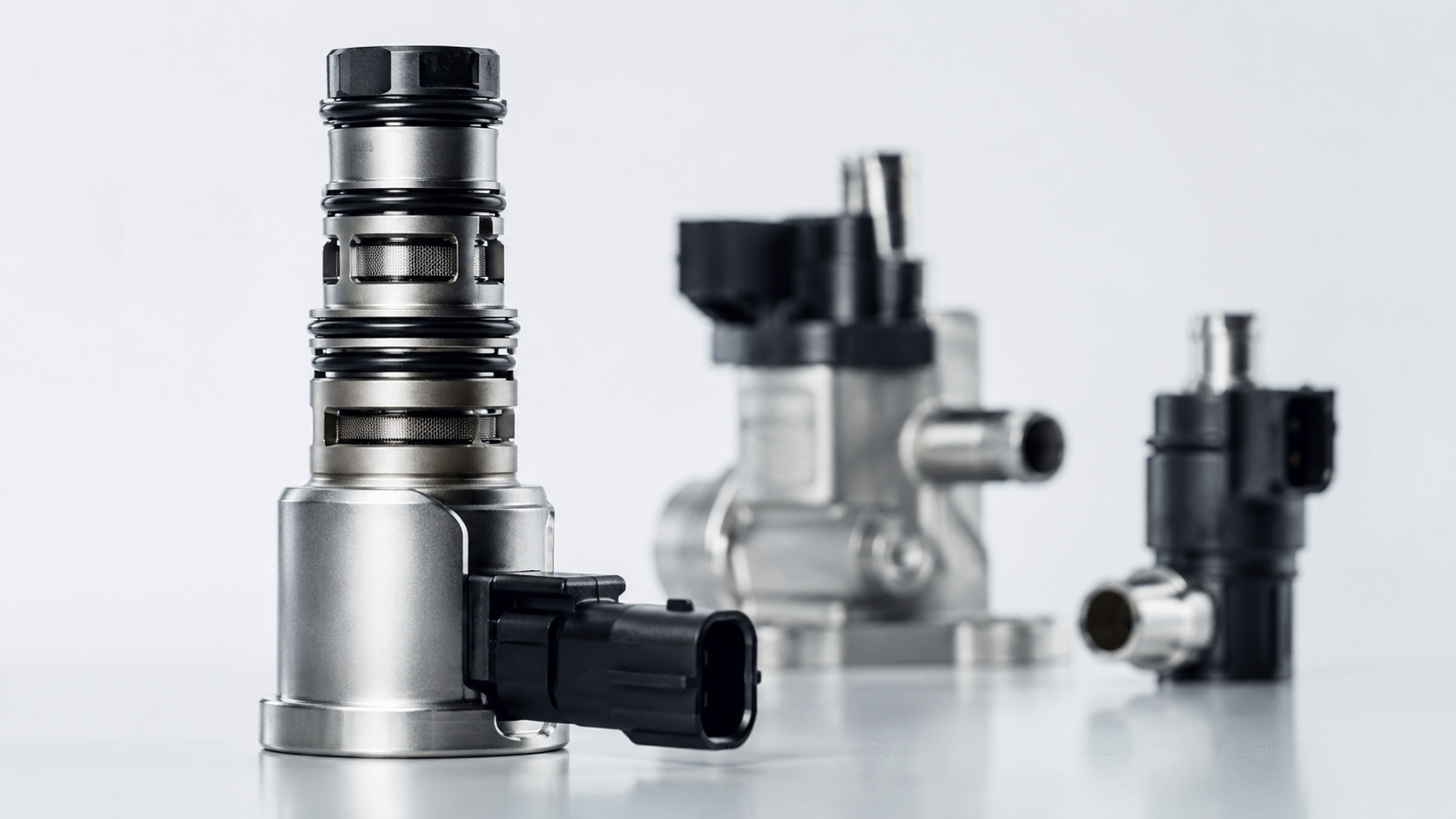
Revenue Mix by Product Category
| Product Group | Revenue (KRW B) | Share | Main Products | Note |
|---|---|---|---|---|
| Drive | 192.8 | ~45% | Hydraulic solenoid valves, fuel-cell solenoid valves | Largest segment. Utilization at 102.9% |
| Electronics | 110.7 | ~26% | Vehicle USB chargers, clocks, cigarette lighters, sensors | Convenience/infotainment applications |
| Control | 85.4 | ~20% | DCT solenoid valves, OPCV, bypass valves | Transmission control focus. Utilization 88.0% |
| Electrification | 41.3 | ~10% | SBW, refrigerant valves, coolant valves | KRW 16.2B (2023) → 41.3B (2025). 2.5x in 2 years |
2025 annual basis. Total ~KRW 430.2B.
Revenue & Margin Snapshot
| Item | 2022 | 2023 | 2024 | 2025 |
|---|---|---|---|---|
| Revenue | 189.6 | 219.6 | 250.2 | 287.2 |
| Op. Profit | 4.0 | 6.2 | 5.6 | 9.6 |
| Op. Margin | 2.1% | 2.8% | 2.2% | 3.4% |
| Net Income | 2.4 | 4.3 | 5.2 | 7.2 |
| OCF | 3.1 | 8.7 | 8.1 | 13.3 |
| CAPEX | 12.5 | 10.1 | 9.1 | 13.3 |
| ROE | 3.1% | 5.4% | 6.2% | 7.9% |
▶ Revenue & Operating Margin Trend (USD M)

Revenue expanded from USD 220M (2023) to USD 250M (2024) and USD 287M (2025), while operating profit dipped in 2024 (USD 6M, OPM 2.2%) before accelerating to USD 10M in 2025 (OPM 3.4%). The 2024 dip matters — it shows margin is not on a straight line — but the recovery into 2025 and 2026Q1 (OPM 4.5%) suggests the improvement is more structural than seasonal.
Recent Quarterly Performance
| Quarter | Revenue | Op. Profit | Op. Margin | Net Income |
|---|---|---|---|---|
| 2026Q1 | 75 | 3 | 4.5% | 3 |
| 2025Q4 | 74 | 1 | 1.0% | 1 |
| 2025Q3 | 73 | 3 | 4.1% | 3 |
| 2025Q2 | 72 | 4 | 5.1% | 3 |
| 2025Q1 | 68 | 2 | 3.2% | 1 |
| 2024Q4 | 66 | -1 | -1.5% | 1 |
| 2024Q3 | 64 | 2 | 2.7% | 1 |
| 2024Q2 | 62 | 3 | 4.6% | 2 |
▶ Quarterly Revenue & Operating Margin Trend (USD M)

The quarterly pattern shows a recurring Q4 dip: 2024Q4 posted an operating loss (-1.5% OPM), and 2025Q4 compressed to 1.0%. This appears to be a year-end cost settlement pattern rather than a structural issue, but it needs to be monitored through 2026Q4. The 2026Q1 rebound to 4.5% OPM is encouraging.
Industry Context & Competitive Position
Unick originally localized automatic transmission solenoid valve technology through a partnership with Japan’s TOSOK (now Nidec Tosok). That lineage defines the competitive landscape: Nidec Tosok remains the most direct global competitor in AT/CVT control valve assemblies, while BorgWarner competes in AT/CVT/DCT solenoid modules. Bosch, Continental, and ZF compete at the system level but occupy a different tier as Tier-0.5 system integrators. Hyundai Transys is best understood as a key customer and transmission system owner rather than a direct competitor.
| Product Area | Unick Products | Comparable Competitors | Interpretation |
|---|---|---|---|
| Transmission solenoid valves | AT/DCT/CVT solenoid valves | Nidec Tosok, BorgWarner | Most direct product-level competitors |
| System-level powertrain control | Control modules, powertrain systems | Bosch, Continental, ZF | Larger global system suppliers; Unick competes at component level |
| Electrification thermal / shift-by-wire components | Coolant valves, refrigerant valves, SBW | Hanon Systems, Woory Industrial, Inzi Controls | Relevant for future electrification growth |
| Hyundai/Kia transmission chain | Solenoid valves for transmission systems | Hyundai Transys | Key customer/system owner rather than direct competitor |
Unick’s differentiation is component-level specialization and cost competitiveness within the Hyundai Motor Group and Tier-1 supply chain. The company holds 266 patents (230 domestic, 36 overseas) and operates the drive segment at 102.9% utilization. The competitive edge is not about having the broadest system offering — it is about maintaining reliable, cost-effective valve production while expanding into electrification thermal management.
Balance Sheet & Financial Stability
| Year | OCF (USD M) | CAPEX (USD M) | FCF (USD M) | ROE (%) |
|---|---|---|---|---|
| 2022 | 3.1 | 12.5 | -9.4 | 3.1% |
| 2023 | 8.7 | 10.1 | -1.4 | 5.4% |
| 2024 | 8.1 | 9.1 | -1.0 | 6.2% |
| 2025 | 13.3 | 13.3 | ~0 | 7.9% |
All financial values in USD million, approximate at ~1,498 KRW/USD. Currency note: KRW figures are converted into USD at approximately 1,498 KRW/USD, using the exchange rate applied at the time this analysis was prepared. Market cap ~USD 54M. Debt-to-equity ratio: 119.9% (2025).
FCF has been narrowing: -9.4M (2022) → -1.4M (2023) → -1.0M (2024) → 0.0M (2025). OCF reached USD 13.3M in 2025 but CAPEX also reached USD 13.3M, so the company is not yet generating meaningful free cash. The debt-to-equity ratio at 119.9% (2025) adds financial leverage risk if the cycle turns. The next milestone is FCF turning clearly positive.
Key Risks
Investment Considerations:
1) CAPEX burden and FCF pressure. In 2025, OCF (KRW 19.9B) and CAPEX (KRW 20.0B) were nearly identical. The company is reinvesting almost all operating cash into equipment. If new model volumes or electrification orders disappoint, depreciation drag could outweigh revenue gains.
2) Long-term BEV transition risk. Hybrid expansion supports Unick’s legacy valve demand in the near-to-medium term, but a faster shift toward pure BEVs could reduce demand for traditional automatic-transmission-related solenoid valves. Whether electrification revenue can scale quickly enough to offset that long-term pressure is the key structural question.
3) Price/margin spread compression. Average selling prices have been declining: control segment ASP dropped from KRW 4,841 to KRW 4,289, and drive segment ASP from KRW 3,885 to KRW 3,809. If pricing erosion outpaces cost reduction, margin improvement stalls even as revenue grows.
4) Raw material cost inflation. Aluminum moved from 2,419 to 2,632 USD/t and copper from 9,147 to 9,945 USD/t. The company reports “not applicable” for derivatives hedging, suggesting limited ability to offset input cost swings.
5) Succession overhang. CEO Jae-beom Ahn has moved into the co-CEO role and lifted his stake to 6.04%, but Chairman Young-gu Ahn’s shareholding remains substantial. Further share transfers, inheritance events, or block deals are possible. Succession can also create less obvious incentives around the timing of share-price-sensitive events, because lower share prices can reduce inheritance or gift-tax burdens.
Q4 seasonal margin compression
Both 2024Q4 (-1.5% OPM) and 2025Q4 (1.0% OPM) showed sharp margin drops. Whether this is a year-end cost settlement pattern or a structural issue needs monitoring through 2026Q4.
What to Watch Next
- Whether 2026Q1’s 4.5% OPM sustains into Q2 and Q3, confirming the margin recovery is durable.
- Whether FCF turns clearly positive as CAPEX stabilizes and OCF continues to grow.
- Electrification revenue trajectory: can the 2.5x growth pace (KRW 16.2B → 41.3B) continue into 2026?
- Pricing actions versus raw material trends — ASP declines need to narrow or reverse.
- Succession progress: additional share transfers or governance changes from the An family.
FAQ
QWhat is the core thesis for Unick?
Hybrid expansion supports traditional valve/actuation demand while electrification components (SBW, coolant/refrigerant valves) scale in parallel, so transition risk is diversified rather than binary. The 2025 earnings recovery and 2026Q1 margin follow-through are the financial evidence investors should focus on.
QHow did Unick’s earnings change from 2023 to 2025?
Revenue increased from USD 220M (2023) to USD 250M (2024) and USD 287M (2025). Operating profit dipped in 2024 (USD 6M, OPM 2.2%) before accelerating to USD 10M in 2025 (OPM 3.4%). The company’s operating margin improved from 2.2% in 2024 to 3.4% in 2025, with 2026Q1 showing further recovery to 4.5%.
QIs the electrification business already contributing to revenue?
Yes. Electrification revenue grew from ~KRW 16.2B (2023) to ~KRW 41.3B (2025), a 2.5x increase. At ~10% of total revenue, the absolute share is still small, but the growth rate is the signal — this is already in the revenue line, not just in development pipelines.
QWhy is the PBR low even though earnings improved?
Auto-parts investors typically discount cyclical earnings durability — OEM volumes and raw material inputs can swing, so the market prices in uncertainty about whether operating leverage persists. The debt-to-equity ratio at 119.9% adds another layer of caution. PBR discounts in this sector reflect durability concerns more than balance-sheet weakness alone.
QWhat could reverse the margin recovery?
The main reversal mechanism would be a cost-pricing mismatch: higher aluminum/copper costs without price pass-through, combined with OEM volume softness. ASP declines in the control segment (KRW 4,841 → 4,289) and drive segment (KRW 3,885 → 3,809) are already visible. Competitive pricing pressure can also cap margin leverage.
Disclaimer: This material is provided for informational purposes only and does not constitute investment advice. All figures are based on publicly available filings. Investment decisions should be made at the reader’s own discretion and risk.
Visit the official Unick website for more information.
For more Korean small cap ideas, visit our Korean Small Cap Stocks section.
You can also read our Industry Analysis articles.
Here is my substack. There are more information for value. -> Hanalpha substack