
Executive Summary:
- Moatech is a korean stock where the core bet is a shift from selling stepping motors toward producing vehicle actuators (motor + gearbox + shaft + control + housing), yet the numbers show the market is still waiting for that shift to translate into sustained operating profit—last year revenue was 20.9 USD M with operating margin at -10.0% and 2025 net income at -1.3 USD M.
- Cash generation has been unstable: operating cash flow swung from 5.0 USD M in 2015 to negative levels in 2022–2023 (-0.4 USD M and -1.4 USD M) and turned slightly positive again in 2024 (0.5 USD M), but free cash flow stayed thin or negative (FCF was 0.0 USD M in 2024 and -0.7 USD M in 2025).
- The company’s performance over 2015–2025 is dominated by operating losses in most years—2017 was one of the rare exceptions with operating margin of 2.8%—so the current operating model, not the long-term product story, is driving investor skepticism.
- What matters now: the next proof point is not whether the actuator strategy sounds logical, but whether margin stops deteriorating; 2024 operating margin was -7.1% and slipped again to -10.0% in 2025.
- Key risk in one line: the market will keep discounting Moatech until it sees durable demand and cost control that lifts gross profit into an operating margin range that supports positive cash flow.
Investment View in One Line
Moatech’s actuator pivot has the right direction, but the stock’s near-term fate hinges on whether the company can convert that pivot into consistent profitability rather than recurring losses.
Why This Korean Stock Matters
Moatech matters because its strategy is fundamentally about moving “up the stack” into vehicle actuators, not just selling smaller motor components. That transition is plausible on product logic—an actuator bundles mechanical and control value—but the financial record is harsher than the narrative. Over 2015–2025, the operating line is mostly negative, and even when revenue holds around ~20 USD M, operating margin drifts lower (2023 -7.1%, 2024 -7.1%, 2025 -10.0%). For global individual investors, the key is that this is a korean stock where the market is effectively pricing execution risk, not market opportunity.
Core Investment Thesis
1. Transition from stepping motors to vehicle actuators to improve product mix
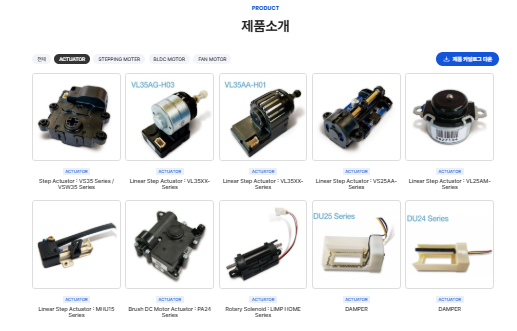
The strategy is to move from “simple stepping motor” sales into producing vehicle actuators (motor + gearbox + shaft + control module + housing). The logic is that actuator markets are larger and typically carry higher value per unit than stepping motors, so the profit model should improve once volumes scale and production stabilizes.
2. A credible thematic fit with EV thermal management and electrification demand
The company’s pivot aligns with the electrification stack, including EV thermal management. The thesis specifically flags “EV thermal management actuators” with an expected mass production timing in 2027, which matters because actuator adoption typically follows customer design cycles that reward suppliers who reach the production ramp phase.
3. Balance-sheet resilience and low interest burden give time to execute
Moatech operates with low debt pressure, supported by substantial cash and short-term financial assets. The thesis highlights cash-like resources and low total debt (with the majority of liabilities linked to trade payables), which reduces the risk of forced cutbacks while the company works through the margin transition.
4. Optionality exists, but the market is judging the core margin math
Beyond vehicle actuators, the company is also tied to communication and home IoT-type actuator applications as part of the broader “control electronics to solution” direction. That upside is optionality, not the main identity—right now investors are still reacting to whether operating losses can steadily shrink as revenue stabilizes.
Business Model Explained
Moatech’s business model is a manufacturing and design capability play in precision motion and control components, concentrated on stepping motors and expanding into vehicle actuator products. The company is trying to monetize more value by bundling mechanical motion with control electronics, moving from component-level supply toward more integrated solutions. The industry context (automotive electrification, digital control, and automation in consumer/industrial equipment) provides a tailwind—but Moatech’s financial history shows that the hard part is not demand direction. The hard part is execution: stable production, customer ramp timing, and keeping cost structure from swallowing incremental revenue.
Revenue & Margin Snapshot
| Item | 2022 | 2023 | 2024 | 2025 |
|---|---|---|---|---|
| Revenue | 21 | 21 | 20 | 21 |
| Op.Profit | -1 | -1 | -1 | -2 |
| Op.Margin | -5.3% | -7.1% | -7.1% | -10.0% |
| Net Income | -1 | -1 | 0 | -1 |
| OCF | -0 | -1 | 0 | -0 |
| CAPEX | 0 | 0 | 1 | 0 |
| ROE | -2.0% | -2.0% | 0.1% | -2.8% |
| Quarter | Revenue | Op.Profit | Op.Margin | Net Income |
|---|---|---|---|---|
| 2025Q4 | 1 | -1 | -182.8% | -1 |
| 2025Q3 | 7 | -0 | -4.5% | -0 |
| 2025Q2 | 7 | -0 | -5.5% | -0 |
| 2025Q1 | 7 | -0 | -4.1% | -0 |
| 2024Q4 | 5 | -0 | -1.2% | 1 |
| 2024Q3 | 5 | -1 | -11.0% | -0 |
| 2024Q2 | 5 | -0 | -8.0% | -0 |
| 2024Q1 | 5 | -0 | -8.0% | -0 |
Revenue trend (annual)
▶ Revenue & Operating Profit Trend (USD M, approx.)

Quarterly revenue & operating margin
▶ Quarterly Revenue & Operating Profit Trend (USD M, approx.)

Revenue has been stuck in a narrow band for much of the last decade, while operating margins have spent most years below zero. The pattern matters because it tells you the company is not simply “waiting for a cycle.” It’s fighting structural margin pressure even when top-line is not collapsing.
Key takeaway from the financial trend
Revenue hovering around ~20 USD M in 2022–2025 did not translate into operating leverage—operating margin worsened from -5.3% (2022) to -10.0% (2025), which points to persistent cost and utilization pressure rather than a one-off industry dip.
What’s Driving the Numbers
Revenue movement looks less like a pure demand story and more like a capacity and mix story. You can see this in how net income occasionally turns around slightly (2024 net income is 0.0 USD M), yet operating profitability continues to fail—suggesting fixed costs, production inefficiencies, and product-mix churn are overwhelming any top-line stability.
Valuation at 0.47x PBR with a small market cap around 33 USD M tells you what the market fears: that low-book-value trading is consistent with a business that may require prolonged time to convert its actuator transition into repeatable margins and cash generation. Compared to other korean stocks in this sector, investors are still demanding proof that the shift to actuators changes the profit equation, not only the product catalog.
A detailed valuation model and scenario analysis are available in the full research report.
Recent Quarterly Performance
Quarterly results reinforce a picture of weak profitability and limited operating momentum. Losses are consistent across quarters, with 2025Q4 revenue at 0.6 USD M and operating loss at -1.1 USD M, while earlier quarters show revenues in the 6.6–7.0 USD M range but still negative operating profits (roughly -0.3 to -0.4 USD M).
| Quarter | Revenue (USD M) | Op. Profit (USD M) | Net Income (USD M) |
|---|---|---|---|
| 2025Q1 | 7.0 | -0.3 | -0.0 |
| 2025Q2 | 6.7 | -0.4 | -0.1 |
| 2025Q3 | 6.6 | -0.3 | -0.2 |
| 2025Q4 | 0.6 | -1.1 | -0.9 |
Industry Context & Competitive Position
The market backdrop is mixed: automotive electrification and digital control should expand actuator demand, yet Moatech’s own results show it is operating through a prolonged weak-to-down cycle. In this environment, suppliers are punished when production utilization falls—fixed costs do not disappear just because the sector is waiting for a later ramp.
Competition is real on scale and execution. Large actuator and motor players can spread R&D and manufacturing overhead across bigger volumes, while niche specialists live or die by specific customer ramps. Moatech’s attempt to broaden from stepping motors into actuators is a rational competitive move, but the financial record implies the company is still in the “conversion and ramp” period where overhead and learning costs dominate.
Balance Sheet & Financial Stability
Financial stability looks better than operating stability. The company’s ability to generate or preserve liquidity matters because actuator transitions often require time, tooling, and engineering support before the margin profile improves; Moatech has historically avoided a debt-driven crisis path, even though profitability is weak.
| Year | OCF (USD M) | CAPEX (USD M) | FCF (USD M) | ROE (%) |
|---|---|---|---|---|
| 2022 | -0.4 | 0.2 | -0.6 | -2.0% |
| 2023 | -1.4 | 0.1 | -1.5 | -2.0% |
| 2024 | 0.5 | 0.5 | 0.0 | 0.1% |
| 2025 | -0.5 | 0.2 | -0.7 | -2.8% |
All financial values are in USD million, approximately at 1509 KRW/USD. ROE and cash flow confirm that liquidity has not yet translated into earnings power.
Valuation Perspective
Moatech’s market cap is about 33 USD M and the current PBR is 0.47x (data as of 2026-03-28). The valuation reads like a market that discounts earnings quality and expects more time for margin stabilization; with operating margins at -10.0% in 2025 and FCF at -0.7 USD M, the balance-sheet “comfort” cannot fully offset the profitability question.
Compared to other korean stocks in this sector, the key differentiator is that many peers have already demonstrated a more durable path to positive operating margins, while Moatech is still proving that its actuator mix changes the profit curve.
A detailed valuation model and scenario analysis are available in the full research report.
Key Risks
Investment Considerations (from investor perspective): watch whether actuator sales actually scale
The transition story is not enough by itself if actual actuator volumes and revenue contributions do not rise meaningfully. Investors should monitor whether the revenue base changes product-mix-wise and whether that shift shows up in gross margin and operating profit.
1. Margin compression risk from utilization and cost structure
When production runs below efficient levels, fixed overhead absorbs incremental revenue, turning stable sales into worsening operating margins. That dynamic has shown up repeatedly with operating margins at -7.1% (2023–2024) and -10.0% (2025).
2. Customer design-cycle delays can create revenue “lulls”
Actuator ramps often depend on automotive electrification schedules and validation timelines. If production transitions lag, the company may keep revenue flat while still bearing engineering and manufacturing costs.
3. Cash flow volatility despite low capex intensity
Even with relatively modest CAPEX (0.1–0.5 USD M in recent years), working-capital effects and operating losses can drive negative OCF, as seen in 2022–2023 and again in 2025 (-0.5 USD M). This makes operating improvement timing more critical than capital spending.
4. Currency and input-cost pressure
If input costs rise while selling prices remain sticky, gross margin falls and operating losses deepen. For a korean stock exposed to automotive supply chains, these pressures can amplify quickly during weak demand periods.
What to Watch Next
- Whether vehicle actuator revenue and margin improve in a way that stops the 2023–2025 operating margin deterioration (-7.1% to -10.0%).
- Quarterly operating profit consistency: a shift from frequent losses toward sustained profitability rather than one quarter of relief.
- Operating cash flow turning positive again (after -0.4 USD M in 2022, -1.4 USD M in 2023, and -0.5 USD M in 2025).
- Evidence of production ramp progress tied to the EV thermal management path toward mass production timing highlighted for 2027.
- Working-capital discipline (receivables/inventory effects), because thin-to-negative FCF has been a recurring theme.
FAQ
QIs Moatech a korean stock to watch for an actuator transition?
Yes for thematic investors, but the financial test is execution: operating margins have been negative most years, so investors should watch whether actuator mix shows up in profitability and cash flow.
QWhat is Moatech’s current valuation multiple?
Moatech has a market cap of about 33 USD M and a current PBR of 0.47x (as of 2026-03-28).
QHas Moatech’s revenue been improving recently?
Revenue has been fairly stable around ~20 USD M, but operating margins worsened, with 2025 operating margin at -10.0%.
QWhat matters most for Moatech in the next few quarters?
Sustained improvement in operating profit and a return to positive operating cash flow, rather than revenue stability alone.
QDoes Moatech generate consistent free cash flow?
No. Free cash flow was positive in earlier years but turned negative in recent years, including -0.7 USD M in 2025.
QWhy does a low PBR still look cautious for Moatech?
Because the company’s earnings quality remains weak—negative operating margins and volatile cash generation outweigh the comfort of book value.
This material is provided for informational purposes only and does not constitute a solicitation or recommendation to buy or sell any security.
All figures, projections, and analyses are based on publicly available information and may differ from actual results; they are subject to change without notice.
The reader bears full responsibility for any investment decisions made. The author accepts no legal liability for any investment outcome arising from reliance on this material.
All investment decisions should be made at the reader’s own discretion and risk. Independent professional investment advice should be sought where appropriate.