
Executive Summary:
- Dongkuk CM is a Korean color-coated and plated steel maker that just went through a margin reset. Revenue kept climbing through 2025 (USD 857M → 1,465M → 1,874M, approx.), but 2025 operating profit swung to –USD 26M as utilization and mix pressured the cost base. The positive read: this is an execution problem, not a demand collapse.
- Three catalysts line up for 2026: (1) the Aju Steel acquisition, completed in late 2024, positions the combined entity as the global leader in color-coated steel capacity; (2) Korea’s construction cycle is showing early bottoming signals — February 2026 construction orders +6.7% YoY, construction completions +3.5% YoY; (3) Korea’s Trade Commission issued a preliminary affirmative determination on April 16, 2026 against Chinese coated-steel imports, recommending provisional anti-dumping duties of 22.34–33.67%.
- Cash generation held up better than the income statement: 2025 OCF came in at USD 93M and FCF at USD 57M, even with a net loss. Leverage rose after the acquisition (reported consolidated total debt around KRW 1.07 trillion / ~USD 72M at year-end 2025), so the margin recovery timing matters for the debt story as well.
- At a PBR of 0.18x on a market cap of roughly USD 117M (as of 2026-04-16, KRW/USD ≈ 1,475), the market is pricing the stock as if the loss year persists. The gap between that pricing and the three catalysts above is the setup.
- Key risk in one line: if utilization dispersion across product lines stays wide and construction demand is slow to recover, fixed-cost absorption keeps pressuring operating margin even as revenue grows.
Investment View in One Line
A cyclical color-coated steel leader trading at 0.18x book, with an M&A-driven scale step, a construction cycle starting to firm up, and a freshly confirmed anti-dumping tailwind — all before the 2026 operating line has been asked to prove anything.
Why This Matters
Dongkuk CM’s product identity sits in premium color-coated steel and digital-printing surfaces — Luxteel and Appsteel brands, sold mainly into appliances and construction. That’s the defensible lane. The 2025 headline — revenue rising into USD 1.87B while operating profit swung to –USD 26M — looks worse than the underlying story because a lot of it is about post-acquisition plant ramp and mix dispersion rather than lost demand. Meanwhile, three independent catalysts (scale, cycle, policy) are converging into 2026, and the market is still pricing the stock as a deep-value loss-maker. That is the setup worth a closer look.
Core Investment Thesis
1. Aju Steel acquisition creates global-scale color-coated leverage
Dongkuk CM completed its acquisition of Aju Steel in late 2024, lifting combined domestic color-coated market share to roughly 34.4% on an export-inclusive basis and giving the company the global-scale crown in color-coated steel capacity. The combined footprint also adds Aju Steel’s Poland and Mexico bases on top of Dongkuk’s Thailand, India, and Mexico coil centers. In a normal-margin environment, scale plus premium product mix translates into operating leverage — volume gains, utilization recovery, and price normalization stack instead of substitute for one another. The 2025 loss year is precisely the year where that leverage is still coiled up.
2. Korean construction cycle is showing bottoming signals
This is not yet a confirmed upcycle, but the leading indicators have turned. Korean construction orders were +6.7% YoY in February 2026, construction completions +3.5% YoY, and housing general-sale volume jumped +52.7% MoM. KDI projects construction investment to move from –9.1% in 2025 to +2.2% in 2026. Nationwide unsold inventory remains heavy (66,208 units, with post-completion unsold at 31,307 units — the first time above 30,000 in 14 years), so “recovery” is too strong a word — “base-forming” fits better. For a company where construction-linked demand is the dominant revenue driver, a cycle base is the condition that lets scale and mix start showing up in operating margin.
3. Anti-dumping preliminary ruling — confirmed, not hoped for
On April 16, 2026, Korea’s Trade Commission issued a preliminary affirmative determination on Chinese zinc and zinc-alloy surface-treated cold-rolled products, recommending provisional anti-dumping duties of 22.34–33.67% by Chinese supplier. The petition was filed in November 2025 by Dongkuk CM, KG Steel, and Sea C&M. The final determination is scheduled for around September 2026. This is the kind of catalyst that moves pricing floors for the domestic color-coated segment — not a thesis resting on hope, but an already-registered regulatory event that changes the import pressure backdrop into the margin recovery window.
Business Model Explained
Dongkuk CM manufactures surface-treated steel — color-coated sheets (for aesthetics and premium finish) and plated/zinc-coated sheets (for corrosion resistance and structural protection). The end markets are roughly split between appliances and construction. Domestic sales account for about 30.3% of revenue and exports for 63.4%, which means the company is genuinely globally exposed rather than a pure domestic name.
The product lineup breaks down roughly as: color-coated steel (35.5% of revenue, mostly appliances and construction), plated/cold-rolled coated steel (25.0%, appliances, construction, autos), architectural color-coated steel for fire doors and solar mounting (9.4%), TV-grade color-coated for display applications (5.3%), design-grade coated steel for sandwich panels (5.7%), automotive-part coated steel including MCCL and battery cell covers (0.5%), with the remainder in merchandise, service, and rental. The digital-printing platform — photo-realistic surface finishes — is the differentiation piece, aimed at customers who care about specification and appearance rather than commodity pricing.
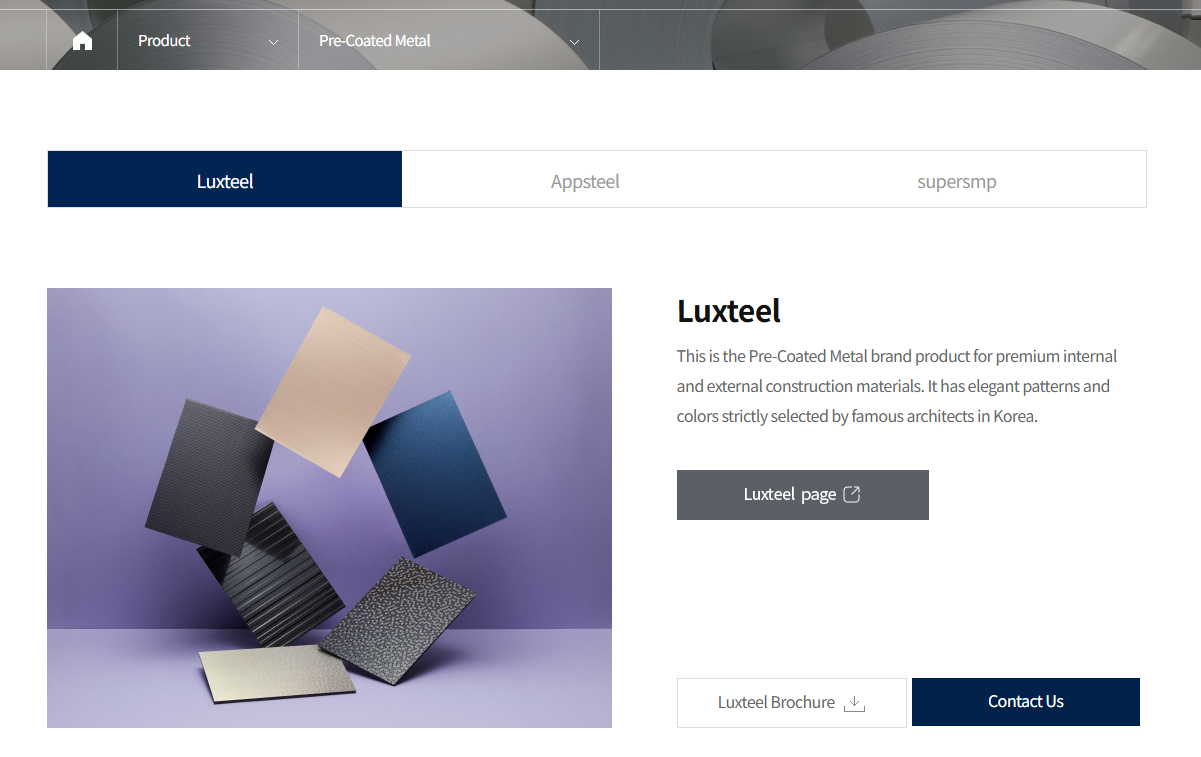
A key operational nuance worth highlighting: utilization is not uniform across product lines. Within the Aju Steel perimeter for 2025, product-line utilization ranged from 25.7% (SILK printing) to 73.0% (electroplating). That dispersion is why margin moves faster than revenue — when under-utilized lines carry fixed overhead, the mix absorbs the pain even if top-line grows.
Revenue & Margin Snapshot
All figures on K-IFRS consolidated basis. USD values converted at KRW/USD ≈ 1,475 (as of 2026-04-16). Figures approximate due to rounding.
| Item | 2023 | 2024 | 2025 |
|---|---|---|---|
| Revenue | 857 | 1,465 | 1,874 |
| Op.Profit | 18 | 52 | -26 |
| Op.Margin | 2.1% | 3.6% | -1.4% |
| Net Income | 7 | 43 | -47 |
| OCF | -41 | 119 | 93 |
| CAPEX | 15 | 19 | 36 |
| ROE | 1.1% | 6.3% | -6.7% |
Revenue trend (annual)
▶ Revenue & Operating Profit Trend (USD M, approx.)

| Quarter | Revenue | Op.Profit | Op.Margin | Net Income |
|---|---|---|---|---|
| 2025Q4 | 450 | -17.2 | -3.8% | -18.3 |
| 2025Q3 | 453 | 1.2 | 0.3% | 0.6 |
| 2025Q2 | 468 | -13.6 | -2.9% | -22.2 |
| 2025Q1 | 506 | 3.3 | 0.7% | -7.5 |
| 2024Q4 | 343 | 1.9 | 0.6% | 5.0 |
| 2024Q3 | 365 | 14.6 | 4.0% | 8.3 |
| 2024Q2 | 382 | 19.7 | 5.2% | 15.5 |
| 2024Q1 | 377 | 16.2 | 4.3% | 14.5 |
Quarterly revenue & operating margin
▶ Quarterly Revenue & Operating Profit Trend (USD M, approx.)

Key takeaway from the financial trend
Revenue kept climbing through 2025, but operating margin collapsed — a classic steel-margin scissor where cost absorption overwhelms top-line growth. That also means the repair is a margin story, not a demand story.
What’s Driving the Numbers
Revenue grew across 2023–2025 largely because the Aju Steel acquisition added scale and broadened the customer footprint, but the 2025 operating swing to –USD 26M tells a different story from the top line. Three forces are moving at once: (1) raw-material direction was split — HRC prices eased in 2025 while zinc pushed higher, so input-cost relief on one side got offset on the other; (2) product-line utilization diverged materially after consolidation (25.7% to 73.0% on Aju’s product perimeter), which kept fixed-cost absorption uneven; (3) Chinese coated-steel imports continued to weigh on domestic pricing until the April 2026 preliminary anti-dumping ruling.
The flip side of that operating loss is the cash statement. 2025 OCF was USD 93M and FCF was USD 57M — not as strong as 2024’s USD 119M / USD 100M, but clearly positive, which indicates working-capital behavior and depreciation are cushioning the P&L hit. For a cyclical steel processor with elevated post-acquisition debt, that cash-generation cushion is what buys time for the margin repair.
At a PBR of 0.18x and 2025 PER not meaningful given the net loss, the current market cap of roughly USD 117M implies the market is extrapolating the 2025 loss year rather than pricing in any of the three catalysts. That is the gap worth examining.
A detailed valuation model and scenario analysis are available in the full research report.
Recent Quarterly Performance
The last four quarters tell a choppy but informative story. Q1 2025 posted USD 3.3M operating profit on USD 506M revenue (0.7% margin), then Q2 flipped to –USD 13.6M (–2.9%), Q3 stabilized at barely positive USD 1.2M (0.3%), and Q4 weakened again to –USD 17.2M (–3.8%). Revenue held in a tight band around the mid-USD 450M–500M range, so the swings are not about demand cliffs — they are about cost timing, input spread, and utilization feeding through contracts with a lag. That pattern reinforces the case that 2026 is an execution story: margin repair should lead, or at least match, revenue in any genuine recovery.
Macro Context: Korean Construction Cycle
Because construction-linked demand is the dominant end-market driver, the Korean construction cycle is a direct input to the Dongkuk CM margin story. The headline read: base-forming, not recovery.
- Construction orders: KRW 12.9 trillion in February 2026, +6.7% YoY, driven by private sector (+11.1% YoY) on redevelopment/reconstruction; public orders –6.6% YoY.
- Construction completions: KRW 10.9 trillion in February 2026, +3.5% YoY — first positive reading after prolonged contraction, supported by public sector SOC execution.
- Housing general-sale: +52.7% MoM in February 2026.
- Unsold inventory: 66,208 units nationwide (–0.6% MoM); post-completion unsold at 31,307 units, the first time above 30,000 since March 2012 — concentrated in non-capital regions (84.5% of post-completion unsold).
- KDI construction-investment forecast: –9.1% in 2025 → +2.2% in 2026.
The picture is mixed but directionally constructive. Leading indicators (orders, housing sales) are improving, while lagging stress (post-completion unsold) is still building. For a color-coated supplier, that is the setup where volume starts to firm before pricing fully repairs — consistent with an early-stage cyclical base rather than a late-stage rally.
Industry Context & Competitive Position
Korea’s color-coated steel market is led by four domestic players — KG Steel, Dongkuk CM, POSCO Steelion, and Aju Steel — with Sea C&M also a significant participant. Dongkuk CM, historically #2, moved into global leadership in color-coated capacity after the Aju Steel acquisition, taking combined export-inclusive market share to approximately 34.4% (from ~29.7% standalone) and domestic share toward the 30% handle.
Raw-material exposure is mainly to HRC (hot-rolled coil) and zinc. In 2025, HRC declined (KRW 769k/ton → 736k/ton) while zinc rose (KRW 4,092k/ton → 4,295k/ton), illustrating why margin direction cannot be summarized by a single cost line. The digital-printing capability (photo-realistic coated steel surfaces) and the Luxteel/Appsteel brand positioning are what separate Dongkuk CM from commodity plays; whether that differentiation shows up in operating margin depends on utilization mix catching up.
| Company | Position | Key Products & Strengths | Notes |
|---|---|---|---|
| KG Steel | Korea color-coated #1 | Color-coated & plated steel; appliance/construction focus | Solid domestic footprint |
| Dongkuk CM | Korea #2, global #1 in color-coated capacity (post-Aju) | Premium color-coated (Luxteel/Appsteel), digital-printing surfaces, architectural & solar-mount coated steel | Coil centers in Thailand, India, Mexico; Aju adds Poland & Mexico |
| POSCO Steelion | Korea color-coated #3 | Color-coated & plated steel | POSCO group sourcing advantage |
| Aju Steel (now Dongkuk CM subsidiary) | Korea #4 → consolidated into Dongkuk CM | Specialized in TV/video-appliance premium color-coated | Poland & Mexico overseas bases |
| Sea C&M | Major domestic player | Color-coated & plated steel | Co-petitioner on Nov 2025 anti-dumping filing |
Balance Sheet & Financial Stability
The balance sheet became heavier after the Aju Steel acquisition. According to news reports, consolidated total debt at year-end 2025 rose to roughly KRW 1.07 trillion (~USD 73M), with net debt around KRW 830B (~USD 56M), while interest expense doubled from KRW 24B to KRW 48B (~USD 1.6M to USD 3.3M). These figures are from media reports and should be cross-checked against the company’s formal annual filings; the direction, however, is unambiguous — leverage went up, and the cost of servicing it moved up with it.
Cash generation has held up in that context. OCF improved sharply from –USD 41M in 2023 to USD 119M in 2024, and stayed solidly positive at USD 93M in 2025 despite the operating loss. That disconnect between loss-making P&L and positive cash flow is typical of a steel restructuring with working-capital tailwinds and non-cash charges, and it is the main reason the stock has not had to face a liquidity narrative.
| Year | OCF (USD M) | CAPEX (USD M) | FCF (USD M) | ROE (%) |
|---|---|---|---|---|
| 2023 | -40.8 | 15.0 | -55.8 | 1.1% |
| 2024 | 118.8 | 18.9 | 99.9 | 6.3% |
| 2025 | 92.9 | 35.8 | 57.1 | -6.7% |
Valuation Perspective
As of 2026-04-16 (KRW/USD ≈ 1,475), Dongkuk CM trades at a market cap of roughly USD 117M, at 0.18x PBR. The 2.7x PER shown in snapshot services is not meaningful for 2025 because net income was negative, and trailing earnings multiples generally become unhelpful precisely when the profitability regime is shifting — which is the situation here.
The more useful valuation lens is what PBR 0.18x implies. A sub-0.2x multiple reflects deep skepticism about sustainable earnings power, typical of a cyclical steel company at the trough. For that multiple to re-rate, the market does not need a growth re-set — it needs multi-quarter evidence that operating margin has stopped swinging between positive and negative. Given the three catalysts (scale, cycle, policy) stacking into 2026, the asymmetric question is whether the market is pricing the loss year as representative rather than transitional.
A detailed valuation model and scenario analysis are available in the full research report.
Key Risks
Investment Considerations: 1) The re-rating timeline depends on multi-quarter operating margin stabilization — this business has already demonstrated that margins can swing from positive to negative within a year, so sustained improvement is the bar, not a single-quarter rebound. 2) Post-acquisition leverage is real. Consolidated debt rose meaningfully and interest expense roughly doubled in 2025, meaning slow demand recovery would translate directly into P&L pressure before it helps the equity story. 3) Trade outcomes are bidirectional. The April 2026 Korean preliminary ruling favors domestic pricing floors, but concurrent U.S. tariff adjustments (early April 2026 news flow on steel tariff-methodology changes) can pressure the export channel, where Dongkuk CM earns roughly 63% of revenue.
1. Fixed-cost absorption across diverging product-line utilization
Aju Steel’s 2025 product-line utilization ranged from 25.7% (SILK printing) to 73.0% (electroplating). Underutilized lines carry fixed overhead that directly pressures per-ton cost, and the company can stay loss-making through periods of revenue growth until that dispersion narrows.
2. Raw-material spread risk (HRC vs. zinc)
2025 saw HRC easing (KRW 769k → 736k/ton) while zinc rose (KRW 4,092k → 4,295k/ton). Opposing moves on the two main input lines make margin direction harder to predict and can extend the period during which the market discounts earnings power.
3. Slow Korean construction recovery
Post-completion unsold housing at 31,307 units — the first 30k+ reading in 14 years — signals that the construction-linked demand recovery is still fragile, concentrated in public-sector orders rather than private building. If the private cycle stays weak, color-coated volume leverage is capped.
4. Trade/regulatory bidirectional risk
The April 2026 Korean anti-dumping preliminary ruling is positive, but the final determination scheduled for September 2026 is not guaranteed to match. At the same time, U.S. steel tariff methodology changes can pressure export conditions, and roughly 63% of Dongkuk CM’s revenue comes from exports.
5. Post-acquisition leverage
Consolidated total debt around KRW 1.07 trillion (~USD 73M), with net debt around KRW 830B (~USD 56M) and interest expense roughly doubling year-over-year in 2025. Slow margin recovery would push interest coverage into the spotlight before equity narrative improves.
What to Watch Next
- Quarterly operating margin stabilizing across at least two consecutive quarters, not a single rebound print.
- Narrowing of product-line utilization dispersion at the Aju Steel perimeter.
- Final anti-dumping determination around September 2026 and provisional duty implementation.
- Korean monthly construction orders / completions / post-completion unsold housing trend.
- OCF-to-operating-profit convergence as evidence that cash-flow quality is matching reported earnings.
FAQ
QWhy is Dongkuk CM worth watching now?
Three catalysts are lining up into 2026: the Aju Steel acquisition (global-scale color-coated capacity), early construction-cycle bottoming signals in Korea, and the April 16, 2026 preliminary affirmative anti-dumping ruling on Chinese coated-steel imports. The stock is still priced at 0.18x PBR as if the 2025 loss year is the new normal.
QWhy did operating profit turn negative in 2025 while revenue grew?
It’s a cost-absorption and mix issue, not a demand collapse. Product-line utilization diverged materially after the Aju Steel consolidation (25.7% to 73.0%), raw-material spreads moved against the company on zinc while HRC eased, and Chinese import pressure held domestic pricing floors down. The April 2026 anti-dumping ruling addresses the last of these.
QHow should investors read strong cash flow alongside a net loss?
It usually reflects timing: working-capital movements, non-cash depreciation on expanded plant, and cost recognition lagging cash receipts. Positive OCF reduces near-term liquidity stress and buys time for margin repair, but it doesn’t on its own guarantee that reported earnings quality has returned.
QWhat is the status of the anti-dumping investigation?
On April 16, 2026, Korea’s Trade Commission issued a preliminary affirmative determination on Chinese zinc/zinc-alloy surface-treated cold-rolled products and recommended provisional duties of 22.34–33.67% to be implemented by the Ministry of Economy and Finance. The final determination is scheduled for around September 2026.
QHow concerning is the post-acquisition debt load?
Based on reports, consolidated total debt rose to roughly KRW 1.07 trillion (~USD 73M) by year-end 2025, with net debt around KRW 830B (~USD 56M) and interest expense roughly doubling. The absolute level is manageable given USD 93M OCF, but it raises the importance of margin recovery timing — the sooner operating profit returns, the less the leverage enters the equity narrative.
QWhat does the 0.18x PBR signal?
It reflects deep skepticism about sustainable earnings power at the cycle trough. For that discount to unwind, the market does not need growth — it needs multi-quarter evidence that operating margin has stopped swinging. That is what makes the 2026 execution window the setup.
For more Korean small cap ideas, visit our Korean Small Cap Stocks section.
You can also read our Industry Analysis articles.