
Executive Summary:
- Cherrybro is a vertically integrated poultry producer focused on broiler production, processing and distribution; vertical integration is a central protective feature but also concentrates operational risk.
- Revenue recovered to a pre-pandemic range in 2022–2023 (peaking at 270.9 USD M in 2022) but profitability has been volatile; operating margin fell to 0.7% in 2024 and net income was negative that year.
- Near-term industry risk is elevated due to high-path avian influenza (AI) outbreaks and working-capital pressure; the company shows a weak liquidity profile in 2024 and a negative PER (-5.6x) with PBR 0.58x as reported.
Investment Highlights
1. Insider Buying by the Largest Shareholder
The company’s largest shareholder has been actively purchasing shares in the open market in 2026.
-
Approximately KRW 300 million worth of shares purchased in January 2026
-
An additional KRW 500 million purchase planned for March 2026
This continued insider buying suggests strong confidence from management in the company’s future prospects and valuation.
2. Significant Earnings Turnaround in 2025
The company reported a sharp improvement in profitability.
-
2024 Net Income: approximately –KRW 9 billion
-
2025 Net Income: approximately +KRW 24.4 billion
With a current market capitalization of around KRW 48.9 billion, the company is trading at an estimated P/E ratio of roughly 2x, indicating a potentially deep value situation if earnings remain sustainable.
3. Fully Integrated Poultry Value Chain
The company operates a vertically integrated poultry business, covering multiple stages of the value chain:
-
Animal feed production
-
Broiler (chicken) farming
-
Processed chicken products
-
Franchise chicken restaurant brand (Cheogatjip Yangnyeom Chicken)
This integrated structure can help improve cost control, supply stability, and margin resilience compared with companies operating only in a single segment.
4. Expansion of Chicken Franchise Brand into Overseas Markets
The company’s flagship franchise brand Cheogatjip Yangnyeom Chicken has begun expanding internationally.
Recent development:
-
The brand launched a new “Jin Mala Yangnyeom Chicken” menu in Taiwan through a local partnership, marking a step toward broader global franchise expansion.
This expansion could provide a new growth engine beyond the domestic Korean market.
5. Potential Upside from Avian Influenza Developments
Historically, avian influenza has rarely spread to humans. However, recent news reports have highlighted cases of potential human transmission.
If concerns over avian flu intensify globally, poultry-related companies may attract investor attention as thematic plays, potentially driving significant share price volatility.
6. Improving Balance Sheet Trend
Recent quarterly results indicate gradual capital accumulation, suggesting improving financial stability following the earnings turnaround.
Why This Company Matters
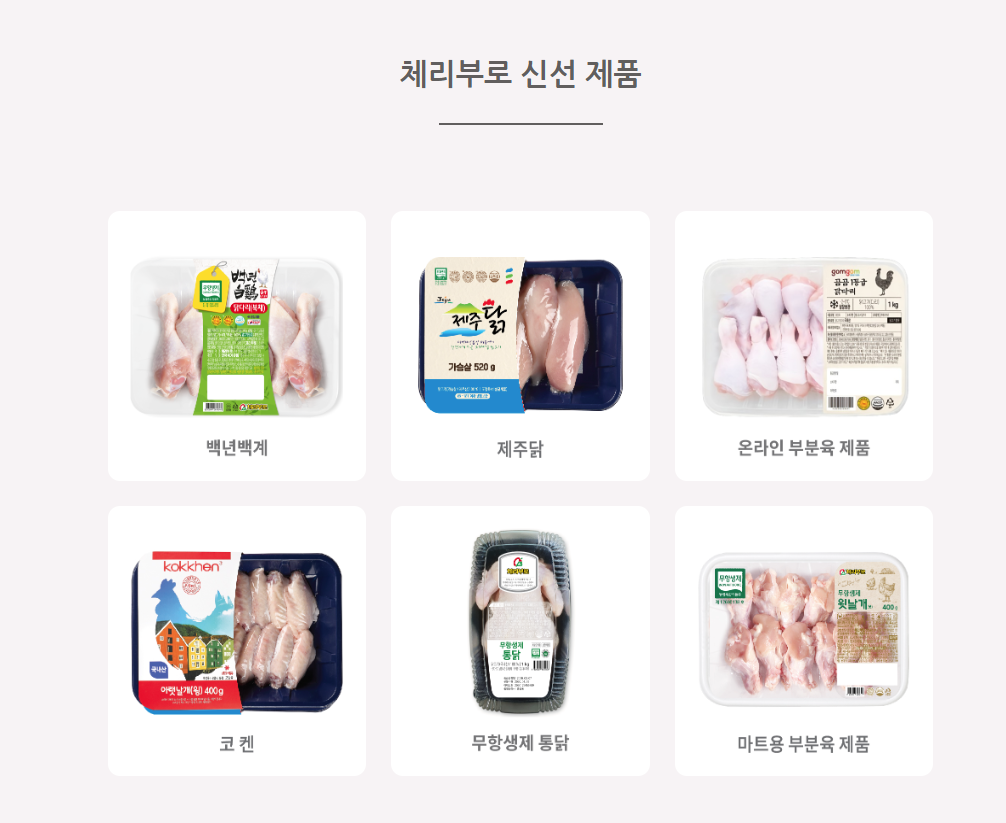
체리부로 (Cherrybro) operates across the broiler value chain — from parent stock and hatcheries through feed, rearing, slaughtering, processing and distribution — positioning the company as a domestic specialist in chicken proteins. This coverage focuses on how that integration supports supply control and cost management, while also exposing the company to concentrated disease and feed-cost risks that can compress margins rapidly.
Business Model Explained
Cherrybro’s model is deliberately vertical: control of seed stock, hatcheries, feed production and processing allows tighter traceability, faster response to quality/safety standards (HACCP, salmonella controls) and potential cost advantages versus independent farming. Sales are predominantly domestic poultry (over 90% of revenue historically) and routed through retail, wholesale and franchise channels — including group-owned brands and the deli/oven-chicken franchise arm (DeliQueen). The company invests modestly in R&D and biosecurity measures via an in-house research center; these investments are operationally important but small in absolute spend (R&D expense ~5.6 USD M in 2024 reported as cost).
Revenue & Margin Snapshot
| Item | 2021 | 2022 | 2023 | 2024 |
|---|---|---|---|---|
| Revenue | 245 | 271 | 269 | 258 |
| Op.Profit | 1 | 11 | 14 | 2 |
| Op.Margin | 0.6% | 4.1% | 5.3% | 0.7% |
| Net Income | -19 | 6 | 10 | -6 |
| OCF | -9 | 10 | 27 | 0 |
| CAPEX | 4 | 4 | 6 | 12 |
| ROE | -59.4% | 10.9% | 13.7% | -8.6% |
| Quarter | Revenue | Op.Profit | Op.Margin | Net Income |
|---|---|---|---|---|
| 2025Q3 | 73 | 4 | 5.3% | 2 |
| 2025Q2 | 71 | 6 | 7.8% | 6 |
| 2025Q1 | 61 | 2 | 3.6% | 1 |
| 2024Q4 | 61 | -3 | -5.2% | -8 |
| 2024Q3 | 70 | 4 | 6.4% | 5 |
| 2024Q2 | 59 | -1 | -1.3% | -3 |
| 2024Q1 | 67 | 1 | 2.1% | -0 |
| 2023Q4 | 66 | 3 | 4.2% | 3 |
Revenue trend (annual)
▶ Revenue & Operating Profit Trend (USD M, approx.)

Quarterly revenue & operating margin
▶ Quarterly Revenue & Operating Profit Trend (USD M, approx.)

Below is a multi-year view of revenue and margin dynamics (values shown in USD million). All financial values in this report are approximate at 1,400 KRW/USD and formatted in USD M.
Recent Quarterly Performance
Quarterly results in 2025 show a return to positive operating margins after a loss in 2024Q4. Seasonality and episodic supply shocks (e.g., 2024 winter AI events) explain much of the quarter-to-quarter swing.
| Quarter | Revenue | Operating Profit | Op. Margin | Net Income |
|---|---|---|---|---|
| 2025 Q3 | 73.1 USD M | 3.9 USD M | 5.3% | 2.1 USD M |
| 2025 Q2 | 71.1 USD M | 5.5 USD M | 7.8% | 6.5 USD M |
| 2025 Q1 | 61.3 USD M | 2.2 USD M | 3.6% | 1.2 USD M |
| 2024 Q4 | 61.0 USD M | -3.2 USD M | -5.2% | -8.0 USD M |
Industry Context & Competitive Position
The Korean poultry sector is exposed to short-term production shocks (notably AI), feed-price volatility (corn, wheat, soybean meal) and concentrated domestic demand via foodservice and franchise channels. Within this context, Cherrybro’s vertical integration is a structural advantage: it supports traceability, coordinated biosecurity and potential cost control. Competitive peers (domestic) include larger integrated groups such as Harim and other mid-sized processors; however, comparable peer valuation or multiple data is not available for this specific coverage. Cherrybro ranks as a leading domestic player in broilers with reported 2024 consolidated revenues equivalent to ~257.8 USD M for the parent operations (note consolidated report lists 3,829 KRW bn in local reporting; converted here for comparability).
Balance Sheet & Financial Stability
Cherrybro’s balance sheet and cash-flow profile indicate elevated leverage and modest cash cushions. Reported metrics show high adjusted liabilities relative to equity (adjusted debt ratio ~170.1% in 2024 in company disclosures), low operating cash flow (OCF ~0.03 USD M in 2024 when converted), and a material stock of short-term borrowings (short-term debt cited at 125.0 USD M in local reporting terms). These figures point to sensitivity to working-capital swings and interest-cost pressure in a higher-rate environment; capital intensity stems from feed, breeding and processing assets.
Valuation Perspective
Current multiples reported in company summary: Market Cap: 500 KRW100M | Current PER: -5.6x | Current PBR: 0.58x. The negative PER reflects recent loss-making periods; PBR below 1.0x suggests market-priced equity below reported book value on a simple ratio basis.
Comparable peer data not currently available for this coverage. As a result, a direct multiple comparision to domestic and global poultry/processors in this note is limited; public peer multiples would be required to place the -5.6x PER and 0.58x PBR into a broader context. The company competes with larger integrated peers (e.g., Harim) that typically trade with different scale and international exposure which materially affects valuation comparators.
Structurally, Cherrybro’s valuation reflects a combination of volatile earnings (sensitivity to AI and feed costs) and balance-sheet constraints. Multiples are compressed by episodic net losses and a weak liquidity profile; the low PBR indicates limited market confidence in near-term equity return on asset trends.
Analyst note included in company metadata (<투자 아이디어>) signals there is an internal view or idea under consideration; readers should treat that as an input to further diligence rather than a valuation conclusion. Scenario framing: if operating margins stabilize in a post-AI environment and working capital is better managed, multiples could re-rate upward relative to current levels; conversely, additional disease outbreaks or feed-cost shocks would likely drive further multiple compression and cash-flow stress.
Key Risks
- Avian influenza (AI) or other contagious livestock disease causing supply disruption to parent-stock, hatching and slaughter volumes.
- Feed-price volatility (corn, wheat, soybean meal) that narrows gross margins due to limited pass-through in domestic contract pricing.
- Liquidity and leverage risk — elevated adjusted debt ratio and low operating cash flow increase vulnerability to interest-rate rises and working-capital shocks.
- Concentration risk: near-100% domestic revenue exposure and reliance on a limited set of distribution channels (retail/franchise/foodservice).
- Regulatory and trade risks — changes to import rules for hatching eggs or processed protein, and tighter biosecurity rules, can raise costs or constrain sourcing flexibility.
What to Watch Next
- Official AI containment updates and government compensation/supply-support measures that affect production recovery timing.
- Quarterly operating cash flow and short-term debt trends — signs of improving OCF or reduced short-term borrowings would ease liquidity concerns.
- Feed-cost trajectory (international corn/soybean prices) and any pass-through to product pricing or contract renegotiations with major customers.
- Performance of DeliQueen franchise expansion and any improvements in processed/added-value margins.
- R&D and biosecurity program outcomes (HACCP, disease-free chick production) that reduce outbreak frequency or severity.
FAQ
QWhat does Cherrybro do?
Cherrybro is a domestic poultry company vertically integrated across breeding, hatcheries, feed, rearing, slaughtering, processing and distribution, primarily selling broiler products to domestic retail, wholesale and franchise channels.
QHow has Cherrybro’s revenue and profitability trended recently?
Revenue recovered to the ~250–270 USD M range in 2022–2023 but profitability has been volatile; operating margin peaked around 5.3% in 2023 and fell to 0.7% in 2024 with a net loss in 2024 driven in part by one-off and outbreak-related impacts.
QWhat are the biggest operational risks for Cherrybro?
The main operational risks are infectious livestock disease (notably avian influenza), feed-price swings, and working-capital stress tied to short-term borrowings and low operating cash flow.
QWhat does the company’s balance sheet look like?
Reported metrics indicate high adjusted leverage and limited cash on hand relative to short-term borrowings, which creates sensitivity to rising interest costs and working-capital needs.
QHow should investors interpret the reported valuation multiples?
The reported PER is negative (-5.6x) and PBR is 0.58x, reflecting recent losses and subdued market expectations; without comparable peer multiple data for this coverage, these multiples primarily indicate market caution rather than an absolute signal of value.
QWhich near-term indicators could change the company outlook?
Key indicators include AI outbreak resolution and production recovery, feed-cost stabilization, improvements in operating cash flow, and progress in franchise/added-value sales that lift margins.
For more Korean small cap ideas, visit our Korean Small Cap Stocks section.
You can also read our Industry Analysis articles.